Imagine that a single drop of ordinary, plain water — landing on your skin — made it erupt. Not a splash of something caustic. Not chlorine, not acid. Just water, the most harmless substance you can name. Within minutes, itchy, sometimes painful welts bloom wherever it touched. For a tiny handful of people on Earth, this isn't a thought experiment. It's simply, unavoidably, their life.
01 · The reactionWhen water leaves a mark
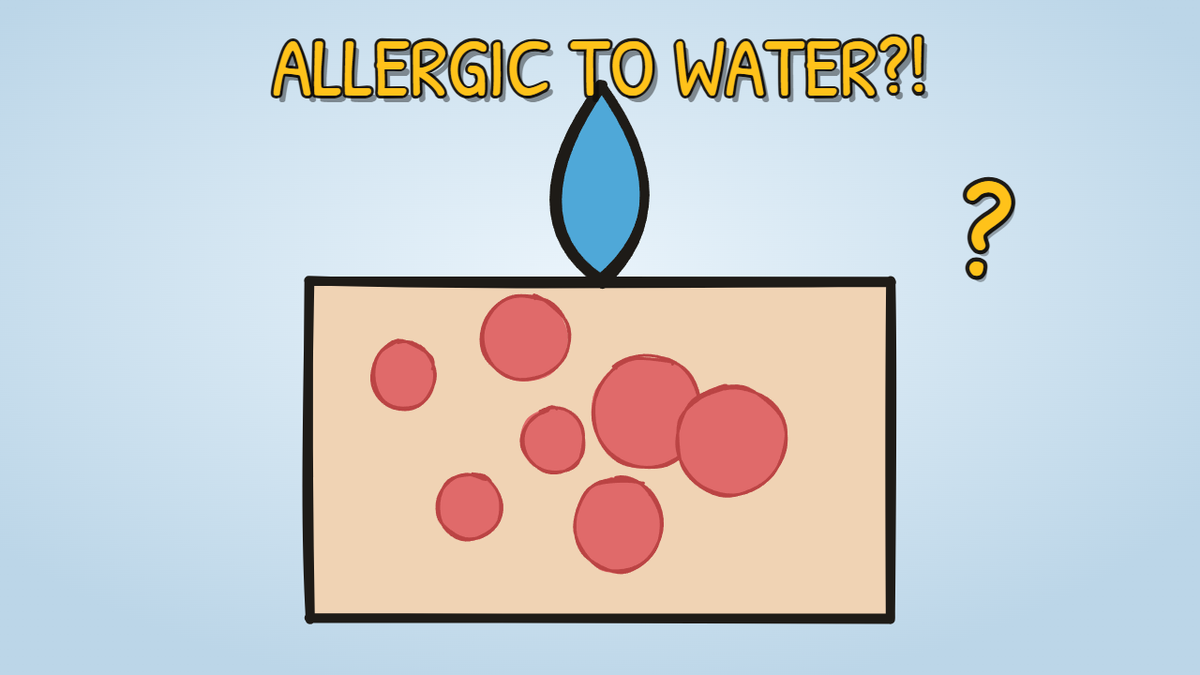
The condition is real and has a name: aquagenic urticaria — “urticaria” being the medical word for hives. Skin touches water, and within about half an hour raised, itchy welts appear, usually across the neck, chest, arms and trunk. They fade on their own an hour or two after the skin dries. And it is astonishingly rare: in all of medical history, fewer than 100 cases have ever been properly documented. If this is the first you’re hearing of it, that’s exactly why.
02 · Not the usual suspectsIt really is the water
Your first instinct is that it must be a reaction to something in the water — it’s too hot, too cold, the chlorine, the salt, the minerals. But doctors have tested all of that, and ruled it out. The reaction is independent of temperature, of pH, of anything dissolved in it. Even pure, distilled water sets it off. What the skin is reacting to is the water itself: the plainest, most stripped-down version of the thing, still enough to trigger the welts.
03 · InescapableRain, sweat, and their own tears
This is the cruel part, because water is everywhere and impossible to avoid. Rain does it. Snow does it. And it gets worse from there: a person’s own sweat, on a hot day or mid-workout, can trigger a breakout — and so, heartbreakingly, can their own tears. The very water their body produces can turn against their skin. A simple shower becomes a countdown to a rash; swimming, washing up and getting caught in a downpour all turn into things to plan around and dread.
04 · The naming problemIs it even an allergy?
So, is it actually an allergy? Not in the strict sense. A true allergy is your immune system overreacting to a specific foreign protein — flagging it, producing antibodies, mounting an attack. But water is just water: a tiny, simple molecule with no foreign protein for the immune system to latch onto. So “water allergy,” while it’s the name that sticks, isn’t quite right. Doctors file it instead under inducible urticaria — hives brought on by a physical trigger. Which leaves the real question wide open: what is actually going on down there?
05 · The leading ideaAn alarm bell called the mast cell
The honest answer is that we’re still not completely sure — but the leading idea goes like this. When water lands on the skin, it seems to interact with something already present, possibly the skin’s natural oils, or sebum, forming or dissolving a substance that soaks inward. That substance is what appears to trip your mast cells — the little alarm bells scattered through your skin — into bursting open and dumping out histamine. And histamine is precisely what causes the itching, the swelling and the hives.
Even that tidy story has a crack in it. In some patients, researchers measured no real rise in histamine after water contact at all — which means the mast-cell explanation may not be the whole picture, and a histamine-independent pathway could be doing part of the work. The best current guess still has a hole in it.
06 · The small mercyThey can usually still drink it
There is, at least, one piece of good news buried in all this. For most people with aquagenic urticaria, the reaction is purely to water touching the skin — so they can generally still drink water, and stay hydrated, without a problem. It isn’t universal; a few case reports describe systemic or digestive symptoms tied to swallowing water. But for the majority, the danger is contact, not the glass. Beyond that, the condition is managed rather than cured: antihistamines to blunt the histamine response, barrier creams before exposure, and a lot of careful avoidance.
07 · The payoffSo why are a few people allergic to water?
Sit with the sheer strangeness of it. Water covers most of the planet. It falls out of the sky. It makes up around sixty percent of your entire body. It is, without any real competition, the most ordinary and essential substance in your whole life. And a small number of people simply cannot let it touch their skin without breaking out in hives — not because of anything in it, but because of the water itself. It isn’t quite an allergy. The mechanism is still half a mystery. And that, in the end, is the honest answer: it’s real, it’s rare, and we still can’t fully explain it.
The animated version
Same answer, told as a little animated story with the strange little stickman acting it out. Dry, quick, and — obviously — correct.
▶ Video dropping soon — subscribe on YouTubeQuick questions
What is aquagenic urticaria?
It's an extremely rare form of inducible urticaria (hives) in which skin contact with water triggers itchy, sometimes painful welts, usually within about 30 minutes. The reaction is to water contact itself — not its temperature, acidity, or anything dissolved in it.
Can you actually be allergic to water?
Not in the strict sense. A true allergy is your immune system producing IgE antibodies against a specific foreign protein — and water is far too small and simple a molecule to act as one. So "water allergy" is a popular nickname; medically it's a physical, or inducible, urticaria, and the exact trigger is still debated.
Can people with a water allergy drink water?
For most, yes. Aquagenic urticaria is usually a skin-contact reaction, so the majority of sufferers can still drink water and stay hydrated normally. A small number of case reports describe systemic or digestive symptoms tied to swallowing water, so it isn't universal — but drinking is generally not the problem that touching is.
What triggers aquagenic urticaria?
Any liquid water on the skin — a shower, a swim, washing up, getting caught in the rain, or snow. Because it's water itself, a person's own sweat on a hot day and even their own tears can set off a breakout. Temperature, pH and salt content make no difference.
How is aquagenic urticaria treated?
There's no cure, so treatment manages symptoms and limits exposure. Second-generation oral H1 antihistamines are the usual first-line option, sometimes at higher-than-standard doses under a doctor's supervision, and barrier creams applied before water contact can help reduce reactions.
How long do the hives last?
They typically appear within about 30 minutes of water contact and fade on their own within roughly one to two hours of the skin drying. They most often show up on the neck, chest, arms and trunk, and usually spare the palms and soles.
Our sources
// every claim on this page was checked before it went up