Take any large crowd, anywhere on Earth, and count the left-handers. You'll land on roughly the same number every time — about one in ten. What's genuinely strange isn't the number itself, it's how stubborn it is. It holds across countries and cultures. And when we look backwards — at the marks ancient humans left on their own teeth and tools — that same one-in-ten ratio is staring back at us from tens of thousands of years ago. Something has been holding it exactly there for a very long time.
01 · The puzzleA trait that refuses to pick a side
To an evolutionary biologist, a steady ten percent is deeply weird. Traits don’t usually behave this way. Normally a trait is useful, so it spreads until nearly everyone has it — or it’s a liability, so it fades toward nothing. A trait that parks itself at one in ten and stays there for millennia is a genuine anomaly. It suggests something is actively pinning it in place: not a drift toward zero or a march toward one hundred percent, but a balance. And a balance means two forces pushing against each other.
02 · The costLiving in a world built for the right hand
On the face of it, left-handedness looks like a bad deal. We live in a world designed by and for the majority — scissors, can openers, power tools, notebooks, even the little desks in classrooms. Left-handers historically had more accidents with right-handed equipment, and for generations were simply forced to switch as children. There’s even a long-running suggestion that the atypical way a left-hander’s brain divides its labour might carry a small cost of its own, though that part is far from settled. Add it up and there’s a real, steady pressure pushing left-handedness down. Which only sharpens the mystery: if the world keeps shoving back, what on earth is shoving the other way?
03 · The fighting hypothesisThe advantage is delightfully violent
The leading answer goes back to a time when disputes were settled far more often with fists — or with fists holding weapons. Picture a fight. If you’re right-handed, almost every opponent you’ve ever faced has also been right-handed. You’ve spent your whole life learning to read attacks coming from that one side. Now, one time in ten, you run into a left-hander, and everything is mirrored. Their blows arrive from the wrong direction, and your instincts — honed for years against right-handers — are subtly, dangerously off.
Meanwhile the left-hander is having the opposite experience. They’ve spent their entire life fighting right-handers, because that’s almost everyone. They know exactly how to handle you. You have no idea how to handle them. That, in a sentence, is the fighting hypothesis, and its key move is what it identifies as the actual advantage. It isn’t strength and it isn’t speed. It’s pure unfamiliarity — the statistical fact of being rare.
04 · The self-correcting trickWhy it can only ever stay rare
Here’s the elegant part. That advantage exists only while left-handers are rare. If half the world were left-handed, everyone would be perfectly used to fighting them and the surprise would evaporate completely. So the benefit isn’t fixed — it shrinks as lefties become more common and grows as they become scarcer. Biologists call this negative frequency-dependent selection, and it’s a natural thermostat. When left-handers are few, they win more, so the trait spreads. As they multiply, the surprise fades, the everyday costs of a right-handed world take back over, and the trait gets pushed down again. Rare enough to be a threat; common enough to survive. The two forces settle into a balance — and it happens to balance at roughly one in ten.
If this is right, you should be able to see the fingerprint of ancient combat in something completely modern: professional sport. And you can.
05 · The evidence in sportThe tell that isn't about talent
In one-on-one sports where you face a single opponent — boxing, fencing, tennis, table tennis, specialist batting in cricket — left-handers are wildly overrepresented at the elite level. A meta-analysis found lefties made up around 32% of top athletes in interactive sports, versus about 11% in non-interactive ones. In baseball, depending on the exact role, left-handers can range from a fifth to nearly half of the very best players — far more than one in ten.
But the truly persuasive detail is the flip side. Look at sports where you don’t face off against an opponent — darts, gymnastics, snooker, swimming — and the left-handed advantage simply disappears. Lefties sit at their normal ten percent. If left-handedness made you generally more athletic, you’d expect an edge everywhere. Instead the edge appears only where an opponent has to read you. That’s exactly what the surprise story predicts, and it’s hard to explain any other way.
06 · The honest caveatThe leading idea, not a closed case
Now, honesty. This is the leading explanation, not a finished one. It fits the sports data beautifully, and one of its boldest predictions held up: across traditional societies, the more violent the society, the higher its share of left-handers — from around 3% in the most peaceful to around 27% in the most warlike. That’s a striking match. But when other researchers looked at particular nonindustrial societies with very high violence, they didn’t always find the extra left-handers the theory demands. So fighting is probably part of the story, and possibly not all of it.
And handedness is more tangled than any single explanation. It’s about 25% heritable, it’s polygenic — dozens of genes each nudging the odds rather than one master switch — and it’s woven into how your brain splits its work between hemispheres. We’re still untangling how those threads fit together. The fighting hypothesis is the best current account of why the ratio stays put, not a complete theory of what makes any one person a lefty.
07 · The payoffKept around precisely for being unusual
Which leaves us with something genuinely lovely. Left-handedness may have survived, all this time, because it’s rare — a minority that persists not in spite of being unusual, but because being unusual is the entire point. The moment left-handers became ordinary, they’d lose the one thing that kept them around. So no, lefties aren’t a mistake evolution forgot to fix. If the leading idea is right, they’re kept in the deck on purpose — a small, permanent surprise, roughly one in ten of us, held there by the very thing that makes them uncommon.
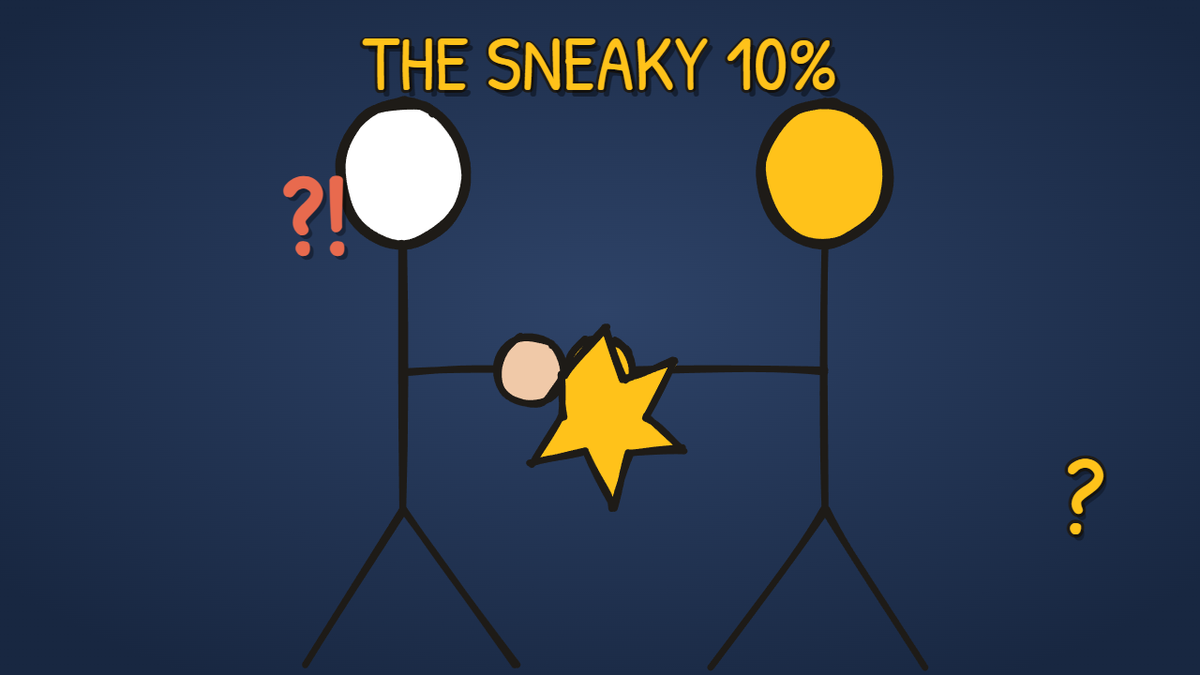
The animated version
Same answer, told as a little animated story with the strange little stickman acting it out. Dry, quick, and — obviously — correct.
▶ Video dropping soon — subscribe on YouTubeQuick questions
What percentage of people are left-handed?
Around 10%. The largest meta-analysis to date — 2.3 million people across 200 studies — puts the best estimate at about 10.6%, with the exact figure drifting between roughly 9% and 18% depending on how strictly you define handedness and how much cultural pressure to switch there was.
Why are left-handers so rare instead of just dying out?
Because being rare is apparently the point. The leading fighting hypothesis says a left-hander's advantage in one-on-one conflict comes purely from being unfamiliar — an opponent nobody has practised against. That benefit is large when lefties are scarce and vanishes if they become common, so the trait self-corrects to a stable minority.
Is left-handedness genetic?
Partly. Twin studies estimate handedness is about 25% heritable, and it's polygenic — a 2020 genome-wide study found dozens of genetic variants each nudging the odds a little, rather than one 'lefty gene.' Most of what decides your handedness still isn't explained by known genes.
Were people left-handed in prehistoric times too?
Yes, at roughly the same rate. Marks on Neanderthal front teeth — scratches left by cutting food held in the mouth — suggest about 93% were right-handed, essentially the modern ratio, going back well over 100,000 years. The 1-in-10 split is very old.
Do left-handers really have an advantage in sports?
In the right kind of sport. A meta-analysis found left-handers made up about 32% of top athletes in interactive sports (where you face an opponent) versus about 11% in non-interactive ones. That gap is the giveaway: the edge is about the opponent's unfamiliarity, not raw talent.
Our sources
// every claim on this page was checked before it went up