For as long as we've had machines to look, we assumed that dying, inside the brain, looked like a fade to black: the oxygen stops, the activity drains away, the line on the monitor goes flat. A calm, tidy picture — the lights quietly going out. And then, in a small number of rare, almost accidental recordings, the dying brain did something nobody expected. It didn't fade. It surged. This is one of the strangest findings in modern neuroscience, and one of the easiest to overstate — so let's walk through exactly what we know, and be ruthless about what we don't.
01 · The accidentThe first human recording, entirely by chance
You can’t plan to record a brain at the moment of death — you never know when it’s coming, and you don’t tend to have someone wired up to an EEG when it does. So the first proper human recording happened purely by accident. In 2022, researchers reported the case of an 87-year-old man who was in hospital, wired to a brainwave monitor so doctors could track his seizures. While that machine was still recording, he had a fatal cardiac arrest. For the first time, we had a continuous EEG running straight through the moment a human brain died.
And it did not simply go quiet. In the window around his heart stopping, the recording showed a rise in a particular kind of activity — not random noise, but structure.
02 · The rhythmWhat gamma waves are, and why they matter here
The activity that rose was in the gamma band. Gamma is the brain’s fast, high-frequency rhythm — roughly 30 cycles a second and up — and it’s the signature of your most switched-on states: intense concentration, vivid dreaming, conscious perception. And, crucially for this story, the act of pulling up a memory. In that 2022 recording, the gamma wasn’t just elevated; it was coupled to slower rhythms in the exact pattern the brain uses when it retrieves memories. Which is, understandably, the detail that gives everyone chills.
But before we run with it, one enormous caveat, stated plainly: this was a single case. One brain. And not a healthy one — it had been injured by bleeding on the brain and a run of continuous seizures. A sample of one, in a damaged brain, proves nothing on its own. It’s a clue, not a conclusion.
03 · The clue in the ratsWhy this wasn't a total surprise
The 2022 case landed the way it did partly because it wasn’t coming from nowhere. There’d been a clue almost a decade earlier — in rats. In 2013, researchers found that when a rat’s heart stopped, its brain didn’t just fade out. Within about 30 seconds of cardiac arrest, it fired off a brief, highly organised surge of gamma that was, for a few seconds, even stronger and more coordinated than when the animal was wide awake — and only then did the EEG go flat. The dying brain, at least in a rat, wasn’t only powering down. It was, momentarily, lighting up.
04 · The four patientsTwo surged. Two didn't.
So in 2023, a team in Michigan looked at four more humans: comatose, dying patients whose families had agreed to withdraw life support, with the EEG left running throughout. And in two of those four, as the heart failed, the same thing happened — a surge of high-frequency gamma, firing up and connecting across a region at the back of the brain that some researchers call the “hot zone,” an area argued to be important for conscious experience itself.
Notice the honest arithmetic, though: two of four. The other two patients showed no such surge. This is not something every dying brain does. It’s something some recorded dying brains have done — which is a very different, and much smaller, claim.
That gamma surge, coupled with slower waves, is the same signature the brain uses to retrieve memories. So a few researchers wonder — very cautiously — whether it could be a last, vivid replay: the neural echo, perhaps, of the "life flashing before your eyes." Wonder is the operative word.
05 · The brakesActivity is not experience
Now I have to slam on the brakes, because this is where being honest matters more than being exciting. What every one of these studies actually recorded is brain activity. It is absolutely not proof of a conscious experience. The two are not the same thing, and treating them as if they were is precisely the mistake to avoid.
Look at how thin the ground is. We’re talking about a tiny handful of recordings, in brains that were already injured or prone to seizures. And here’s the confound that really matters: in the 2023 study, both patients who surged had a history of seizures — and the two who didn’t surge didn’t. That opens an obvious, deflating alternative: the “surge” might be seizure-like electrical activity of a dying, damaged brain, with nothing to do with awareness at all. The researchers said as much themselves, cautioning they couldn’t rule out that the gamma was a pathological process of dying, unrelated to conscious processing. Independent critics have pressed the same point. And above all: not one of these patients could ever be revived and asked what, if anything, it was like. We are reading the smoke and guessing at the fire.
06 · The payoffSo what is really going on at the end?
Here’s the whole truth, caveats and all. The old, tidy picture — the brain just gently switching off — turns out to be incomplete. In rats, and in a small number of human recordings, the dying brain has instead produced a brief, organised surge of the very rhythm associated with a mind that’s wide awake, sometimes in a region tied to consciousness, sometimes carrying the fingerprint of memory recall. That is a genuinely astonishing thing to have caught on tape.
But it is a door cracked open a sliver, not a room we’ve walked into. It’s activity, not proven experience; it’s a handful of injured brains, not a settled rule; and the most romantic reading — that this is the science of the afterlife, or hard proof of what a near-death experience is — races miles ahead of what a couple of seizure-prone recordings can support. So the honest answer to “why do some dying brains blaze with activity at the very end?” is the most unsettling one there is: in a few rare cases, they demonstrably do — and what that final flare is actually like, from the inside, is something nobody has ever been able to come back and tell us.
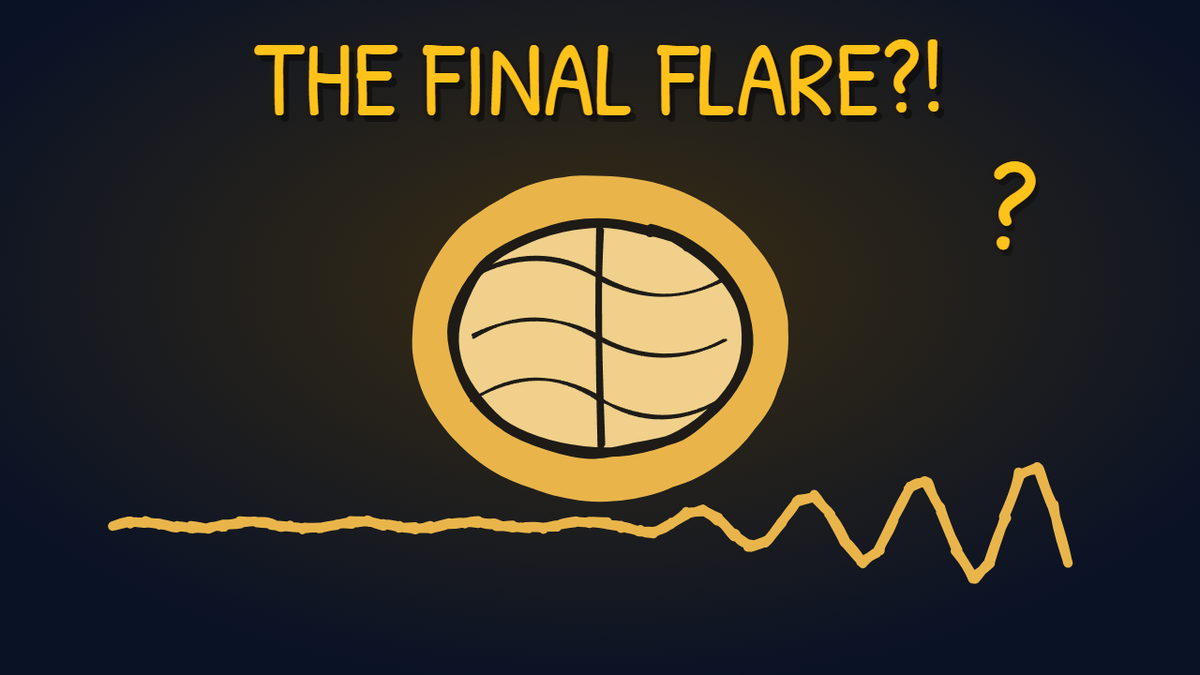
The animated version
Same answer, told as a little animated story with the strange little stickman acting it out. Dry, quick, and — obviously — correct.
▶ Video dropping soon — subscribe on YouTubeQuick questions
Does the brain surge with activity when you die?
Sometimes, in the recordings we have — but not always, and not in everyone. A few studies caught a burst of high-frequency gamma waves in the seconds around the heart stopping. But these are a tiny number of cases, mostly in injured or seizure-prone brains, and in the best human study only two of four patients showed it. It's a real and striking pattern, not a universal rule.
Is the dying-brain surge proof of a near-death experience?
No. This is the line to hold. The surge is brain activity that resembles patterns seen during vivid awareness and memory recall — which is why researchers wonder about a link to near-death experiences. But resembling is not proving. None of these patients could be revived and asked what, if anything, they experienced. It is a fascinating clue, not evidence of a conscious event.
What are gamma waves?
Gamma waves are the brain's fastest common rhythm, roughly 30 Hz and up. They're associated with your most switched-on states — focused attention, vivid dreaming, and, notably, the act of pulling up a memory. That memory link is exactly why a gamma surge at death catches everyone's imagination.
Could the surge just be seizures or dying chemistry?
Quite possibly — and that's a genuine problem for the exciting interpretation. In the 2023 study, both patients who surged had a history of seizures; the two who didn't surge did not. The researchers themselves cautioned it could be a pathological process of dying, unrelated to conscious processing. Critics have argued the same. It's unresolved.
What is the 'hot zone' the surge appeared in?
A region at the back of the brain — the junction of the temporal, parietal and occipital lobes — that some consciousness researchers argue is especially important for conscious experience. The 2023 surge lit up and connected across that area, which is part of why it drew attention. But the hot zone's exact role in consciousness is itself still debated.
Our sources
// every claim on this page was checked before it went up