Imagine that every human face you looked at — your family, your friends, a stranger on the bus — slowly twisted into something monstrous. Features dragged downward. Skin gouged with deep grooves. Ears stretched, eyes pulled wrong. Not in a nightmare, and not in a fog of madness: in broad daylight, on real, living people, while a photograph of that exact same face looks completely, reassuringly normal. This is a real condition, it has a magnificently unpronounceable name, and in 2024 scientists finally found a way to show the rest of us what it actually looks like.
01 · The conditionWhen faces come apart
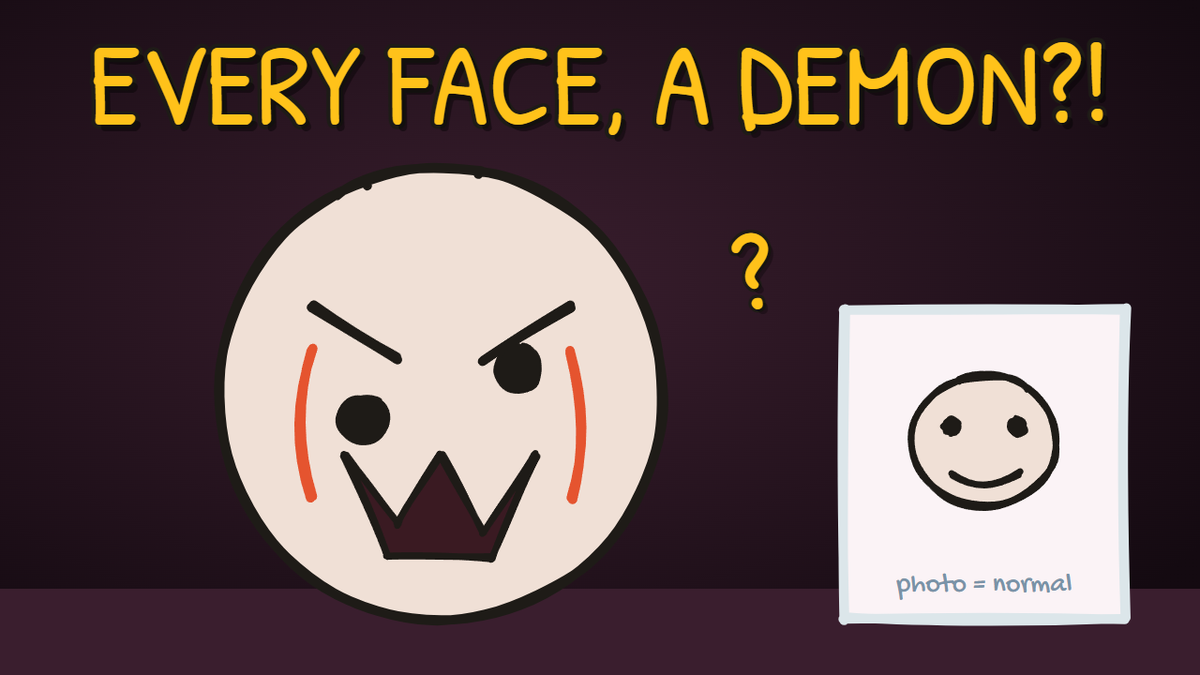
The name is prosopometamorphopsia — mercifully shortened to PMO. It’s a rare disorder of visual perception in which faces appear distorted: drooping, stretched, shifted out of place, sometimes so deeply grooved and fanged that people describe them as demonic. And the truly strange thing is how specific it is. A coffee cup looks normal. A car looks normal. A whole page of text is perfectly fine. It’s only faces that warp. Look at an object — no problem. Look at a person — and their face slowly comes apart.
02 · The problemHow do you photograph a hallucination?
This poses a genuine scientific puzzle. If a distortion exists only inside someone’s head, how could you ever show it to anyone else? You can’t photograph what someone is seeing. For over a century — the first case was described in 1904 — all researchers really had were patients’ shaky, second-hand descriptions of the horror in front of them. Which meant nobody outside the condition had ever actually seen it.
03 · The quirkThe printed photo that cracked the case
Then, in 2024, a case at Dartmouth handed researchers a golden opportunity. Their patient — a 58-year-old man who’d had PMO for around three years — had one very peculiar feature to his condition. He saw the demonic distortions on real, in-person faces, and on faces displayed on a screen. But not on printed photographs. A face on paper looked completely, reassuringly, normal.
That one quirk turned an unseeable hallucination into something you could edit. If a photo on a screen distorts but a photo on paper doesn't, you suddenly have a stable, undistorted reference — and a way to reverse-engineer exactly what the patient sees.
04 · The methodEditing a face into a monster
So the team sat the patient down with a real person on one side and a photo of that exact same person on a screen beside them. He’d study the real, distorted face, then guide the researchers through the edits — stretch this, droop that, deepen the grooves here — reshaping the on-screen photo bit by bit until it finally matched the monster he saw in front of him. The result was the first accurate, photorealistic visualisation of what PMO actually looks like from the inside. For the first time in over a hundred years, the rest of us could see it too.
05 · Not the eyesThe glitch is deeper than that
Here’s the crucial thing, and it’s what makes PMO so revealing: the patient’s eyes were completely fine. The distortion isn’t happening at the eye at all — it’s happening much deeper, in the brain’s dedicated face-processing network. Because your brain doesn’t treat a face like any other object. It has whole regions devoted to nothing but faces, so specialised that a glitch there warps faces alone and leaves the entire rest of the visual world untouched.
A quick note of honesty on the neuroscience: exactly which regions are the culprit is still being worked out. The famous “fusiform face area” is part of the face network, but a 2021 review of a century of cases found the distortions tracked more closely to occipital face regions and their connections than to the right fusiform gyrus specifically. The headline — it’s the face network, not the eyes — is solid. The precise wiring diagram is still a live research question.
06 · The causesWhat sets it off
What triggers PMO is usually some disruption to that face-processing network. Brain infarction is the single most common cause, turning up in about a third of cases; epilepsy, haemorrhagic stroke and severe migraine account for many of the rest. Often doctors can point to a specific damaged spot in the brain. But in roughly a quarter of cases, unnervingly, no structural abnormality is found at all.
And one thing PMO is not is psychosis. It’s a perceptual condition, not a delusion — sufferers know perfectly well that the real face is normal, even as it looks like it’s melting. That distinction matters, because several people with PMO have been misdiagnosed with schizophrenia and put on antipsychotics before anyone realised the problem was in their visual system, not their grip on reality.
07 · Rare or hidden?The count that's almost certainly too low
On paper, PMO is vanishingly rare — that 2021 review counted only around 81 cases in over a century of medicine. But the researchers strongly suspect that number is a wild undercount. Think about it honestly: if every face around you suddenly turned demonic, would you rush to a doctor? Or would you quietly assume you were losing your mind and say absolutely nothing? Tellingly, when one lab set up an awareness website, it heard from roughly 80 more people — people scattered around the world, describing the same symptoms, who’d had no idea anyone else saw what they saw.
08 · The payoffYou build every face you see
Which leaves a genuinely profound thought to sit with. You never simply see a face. Your brain assembles one, from scratch, in a fraction of a second, every single time — and normally it does the job so flawlessly that you never notice any assembly happening at all. PMO is what it looks like when that process slips and you can suddenly see the seams. The face was always being built. It just, usually, comes out right. So the face you’re looking at right now? You’re not really seeing it. You’re seeing your brain’s very good reconstruction of it. Fingers crossed.
The animated version
Same answer, told as a little animated story with the strange little stickman acting it out. Dry, quick, and — obviously — correct.
▶ Video dropping soon — subscribe on YouTubeQuick questions
What is prosopometamorphopsia?
Prosopometamorphopsia (PMO) is a rare disorder of visual perception in which faces appear distorted — features may droop, stretch, shift position, or become deeply grooved, sometimes to the point of looking 'demonic.' Crucially, it's usually specific to faces: objects, text and scenes look normal.
Is it the eyes or the brain?
The brain. In the well-documented cases the eyes are healthy — the distortion arises higher up, in the brain's dedicated face-processing network. That's why only faces warp: the glitch is in the machinery built specifically for reading faces, not in how light enters the eye.
How did scientists show what a PMO patient sees?
In 2024, a Dartmouth team worked with a patient whose distortions appeared on real faces and screens but not on printed photos. They sat him beside a real person and a photo of that same person, and had him direct edits to the photo — stretch this, deepen that — until it matched the distorted face he saw. It produced the first accurate, photorealistic visualisation of PMO.
What causes prosopometamorphopsia?
Usually some disruption to the face-processing network: brain infarction (the single most common cause), epilepsy, haemorrhagic stroke and migraine among them. Doctors can often point to a specific lesion — but in roughly a quarter of cases, no structural abnormality is found at all.
Is PMO the same as psychosis?
No. It's a perceptual condition, not a psychiatric delusion — sufferers know the real face is normal even as it looks distorted. Unfortunately, several people with PMO have been misdiagnosed with schizophrenia and put on antipsychotics before the real, visual nature of their condition was recognised.
How rare is prosopometamorphopsia?
Extremely rare on paper — a 2021 review counted only about 81 published cases in over a century. But researchers strongly suspect that's a large undercount, since many people quietly assume they're 'losing their mind' and never report it. A single awareness website drew reports from roughly 80 more people.
Our sources
// every claim on this page was checked before it went up