Here is something faintly humiliating about being a human being: right now, entirely against your will, your brain may be playing a song you don't even like, that you haven't heard in years, on a perfect and endless loop. You didn't choose it. You can't switch it off. And it's almost never the whole song — it's the same eight seconds, around, and around, and around. Welcome to the earworm, one of the very few things your own mind does to you rather than for you.
01 · The afflictionNine in ten of us, every week
Scientists, who clearly enjoy this, call it involuntary musical imagery — INMI. And almost nobody escapes it: surveys put it at around 90% of people getting one at least once a week, with one large internet study landing on 91.7%. The exact figure wobbles by country and by study, but the headline is unavoidable — this is a near-universal feature of having a brain. Most people don’t mind them. A minority find them genuinely unpleasant. And it’s almost never a whole track playing through: it’s a fragment, a chorus, a hook, fifteen to thirty seconds on a loop. So the real question isn’t whether it happens to you. It’s why your own brain would hijack itself with a song — and so often, a song you can’t stand.
02 · The mechanismThe loop lives in your inner voice
Start with where it lives. Tucked inside your working memory is a kind of inner voice — a small mental rehearsal studio that quietly replays sounds, words and tunes. Normally it’s useful; it’s how you hold a phone number in your head for the ten seconds between reading it and dialling it. But a really catchy hook slips into that studio, hits play, and then simply refuses to lift the needle. The same few seconds, around and around, like a record skipping in a groove.
And here’s the genuinely strange part. Brain-imaging work shows that when you imagine music with no sound at all, the auditory cortex — the part that handles real hearing — lights up almost as if the music were actually playing. Your ears are silent. Your hearing hardware never got the memo. It’s running a concert on an empty stage.
03 · The itchWhy it loops instead of stopping
But why a loop? Why doesn’t it just stop? The leading idea is oddly satisfying: your brain cannot stand an unfinished thing. Psychologists call it the Zeigarnik effect — we nag at incomplete tasks far more than completed ones, which is why an interrupted email haunts you and a sent one evaporates. Marketing researcher James Kellaris borrowed a nicer name for it: a “cognitive itch.”
And an earworm is almost always a fragment — a chorus, a hook, never the whole song. So your brain keeps replaying it, straining to reach an ending it never actually arrives at. It is, quite literally, an itch it cannot scratch. (This is also, as we’ll see, exactly why one of the cures is so satisfying.) Worth flagging: this is the leading explanation, not a closed case — the science of why earworms loop is still an active field.
04 · The recipeCatchy is a formula
The stickiest songs are not random. In a 2017 Goldsmiths study, researchers took thousands of reported earworms, matched 100 frequent offenders against 100 songs equally popular but never named as earworms, and hunted for the difference. They found a recipe. A faster, upbeat tempo. A melody whose overall shape is common and easy to sing — the kind of contour pop is full of. But, crucially, with one unexpected twist buried inside: an odd little leap, or a strange repetition, that most songs don’t have.
Familiar enough to hum without thinking. Just weird enough that your brain trips on it and replays it to take another look. The same few tunes top the earworm charts over and over — things like Bad Romance, Can’t Get You Out of My Head, and, almost cruelly, Don’t Stop Believin’. Catchy, it turns out, is a formula. And a handful of songwriters have it down to a science.
Notice when earworms strike — the shower, the walk to work, the washing-up. They almost always appear when your mind is idle and wandering. Hand your brain a quiet, empty moment, and it raids the jukebox rather than sit in silence.
05 · The triggersAn under-occupied mind plays the hits
That timing is a real clue, not a coincidence. Earworms cluster around low-attention, mind-wandering states — the moments when there’s nothing much to hold your focus. A recent listen will do it. So will the smallest reminder of the tune: a word, a rhythm, a name. Stress feeds it, too. And the more music you love and listen to, the more earworms you get — musicians are absolutely plagued by them, precisely because their inner rehearsal studio is always warmed up. An under-occupied mind, it seems, would simply rather play something than nothing.
06 · The curesGum, endings, and the right kind of distraction
Which is exactly why the cures work. First, the strange one: chew gum. In a real 2015 experiment at Reading, gum-chewers shook their earworms far faster — because chewing quietly hijacks the very same inner-voice machinery the song was using to replay itself. You can’t easily sub-vocalise a tune while your mouth is busy pretending to eat.
Second, and this feels like cheating: just listen to the whole song, right to the end. Give your brain the ending it was so desperate for — close the loop the Zeigarnik effect kept open — and the itch finally goes quiet. Or hand your mind a task that’s absorbing but not impossible. Too easy, and it drifts back to the music; too hard, and you can’t settle at all. The sweet spot is a puzzle just demanding enough to fill the studio with something else.
07 · The payoffSo what is an earworm, really?
It’s not a glitch, and it’s not a sign of anything wrong. It’s simply a loop your mind can’t quite close — spun up by the very same machinery that lets you carry a tune, recognise a friend’s ringtone from two rooms away, or remember a melody at all. The stuck song is the tax you pay for a brain that’s genuinely good with music. And there is, admittedly, one small problem with reading this far. You’ve now spent several minutes thinking about earworms, which means one is, at this exact moment, quietly loading. You’re welcome.
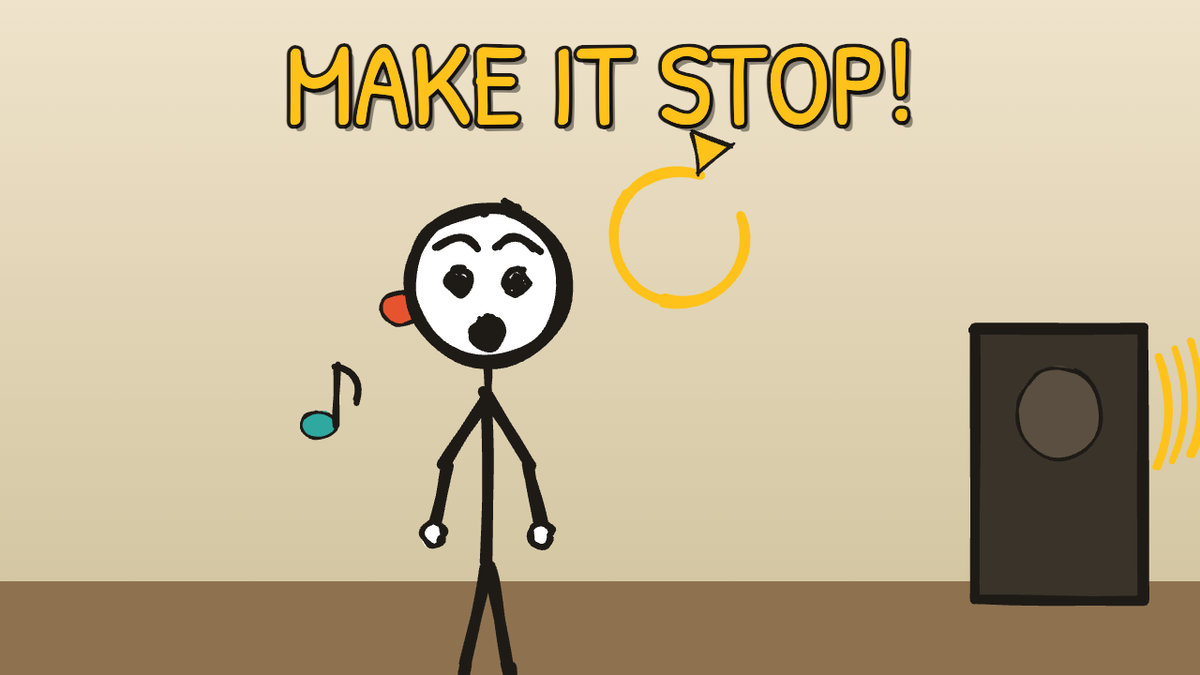
The animated version
Same answer, told as a little animated story with the strange little stickman acting it out. Dry, quick, and — obviously — correct.
▶ Video dropping soon — subscribe on YouTubeQuick questions
How do I get rid of an earworm?
Three things have real evidence behind them. Chew gum — in a 2015 Reading experiment it cut earworms sharply, because chewing hijacks the same inner-voice machinery the song was using. Listen to the whole song to the end, which gives your brain the ending it was chasing. Or take on a task that's absorbing but not impossible — too easy and your mind drifts back to the tune, too hard and you can't settle.
Why do I get songs stuck in my head that I don't even like?
Because liking the song isn't the point — stickiness is. Earworms are usually a fragment, not the whole track, and the catchiest fragments share a specific melodic recipe. A song you find annoying can hit that recipe perfectly, which is why the tune that loops is so often one you'd never choose to play.
Is having a song stuck in your head a sign of a problem?
Almost never. Involuntary musical imagery is an ordinary feature of a healthy, music-literate brain — around 90% of people get earworms weekly. Most episodes are neutral or even pleasant; only a minority are genuinely bothersome. It's simply a loop your mind can't quite close, not a warning sign.
What kinds of songs are most likely to become earworms?
A 2017 Goldsmiths study of thousands of reported earworms found they tend to have a faster, upbeat tempo, a common and easy-to-sing overall melodic shape, and — crucially — one unusual twist, like an odd leap or repetition. Songs that topped the list included Bad Romance, Can't Get You Out of My Head, and Don't Stop Believin'.
Why do earworms strike when I'm in the shower or on a walk?
Because an under-occupied mind reaches for the jukebox. Earworms cluster around low-attention, mind-wandering moments — showering, commuting, washing up — when there's nothing much to hold your focus. A recent listen, stress, or the faintest reminder of a tune can all set one off.
Our sources
// every claim on this page was checked before it went up