Picture it. You're standing somewhere high — a balcony, a cliff path, the rail of a bridge. You feel completely, perfectly fine. And then, out of nowhere, a small, calm voice in the back of your head says: you could just step off. You blink. You take a step back, a little rattled. You don't want to jump. You have never wanted to jump. So what on earth was that? Reassuringly, it turns out to be one of the loveliest facts about your own brain.
01 · The nameThe call of the void
That strange flicker has a name. The French call it l’appel du vide — the call of the void — and psychologists call it the high place phenomenon. Before you start quietly worrying about yourself, three things are worth knowing straight away. It is astonishingly common. It has almost nothing to do with wanting to die. And the best explanation we have for it is, genuinely, rather comforting.
02 · The studyYou are very much not alone
In 2012, a psychologist named Jennifer Hames ran the first proper study of it at Florida State University. She asked more than four hundred people one blunt question: have you ever felt the sudden urge to jump from a high place? Here’s the part that should put you at ease. More than half of the people who had never once had a dark or suicidal thought said yes — they’d felt it too. Among people who had experienced suicidal thoughts at some point, it was over three-quarters. The pattern told the researchers this isn’t a warning sign lurking in a troubled mind. It’s just a quirk of an ordinary, healthy brain.
03 · The rangeIt isn't only heights
And it isn’t only ledges, either. Maybe you’re driving, and a thought darts across your mind — what if I just twitched the wheel into the oncoming lane? Maybe you’re holding a kitchen knife, or standing at the edge of a train platform, and your brain briefly, horribly, offers up the single worst thing you could possibly do. It’s the same phenomenon: your mind flashing you a what-if you would never, ever act on. Intrusive thoughts like these are near-universal and harmless — a normal glitch in an otherwise well-behaved mind.
04 · The precedentPoe named it 180 years ago
If that sounds familiar, it should — we’ve known about this for a very long time. Back in 1845, Edgar Allan Poe wrote a whole essay on it, calling it the imp of the perverse: that little inner gremlin quietly suggesting the one thing you absolutely must not do. And he nailed the version on the ledge exactly, writing that “because our reason violently deters us from the brink, therefore do we the most impetuously approach it.” The precipice, the plunge, the pull toward the thing you’re most desperate to avoid — Poe had the whole feeling pinned before psychology had a lab to test it in.
05 · The mechanismYou run on two brains at once
So what’s actually going on up there? The leading explanation starts with a useful simplification: you run on two systems at once. There’s a fast one — an ancient alarm that can react in about a tenth of a second, long before you can consciously think — and a slow one, the conscious narrator, the voice you think of as you, who explains what just happened and always arrives a beat or two too late. Walk up to the edge, and your fast brain takes one look at the drop and fires a single, sensible command: danger — get back. You flinch. You step back. All before your slow, thinking mind has even worked out what’s happening.
Your slow narrator catches up, notices you just lurched backwards for no obvious reason, and writes a story to explain it — and gets it exactly backwards. The alarm meant stay alive, move away. What you consciously hear is wait… did part of me want to jump?
06 · The misreadThe signal was survival
That, at least, is the leading interpretation — and it’s worth flagging that it’s a well-argued theory rather than a closed case. But it fits the feeling uncannily well. The signal your body sent was pure self-preservation: back up, you’re too close to the edge. The caption your conscious mind wrote over it — the story it told to explain a flinch it didn’t order — became the call of the void. You didn’t feel an urge to jump. You felt an urge to live, and then misheard it.
07 · The patternWhy the anxious feel it most
This neatly explains who tends to feel it the most. Research links the phenomenon to something called anxiety sensitivity — basically, how tuned-in you are to your own body. If you’re the sort of person who notices every flutter of your own heartbeat, you’re simply better at hearing that internal alarm go off, and better at being startled by it. A 2020 study in Germany found that around 60% of an online sample recognised the feeling, and that anxiety sensitivity tracked with it. So it really isn’t a death wish. It’s a slightly oversensitive smoke detector, doing exactly the job it was built to do.
08 · The payoffAn urge to jump affirms the urge to live
Which is why Hames gave her study what might be the most reassuring title in all of psychology: an urge to jump affirms the urge to live. That unsettling little flicker on the bridge isn’t a glimpse of some hidden darkness inside you. It’s the precise opposite — your brain caring so ferociously about keeping you alive that it yanks you back from the edge, then completely fumbles the explanation. So the next time the void gives you a call, remember what’s actually shouting down there: not a sinister urge from the deep, but a tiny, panicking lifeguard who’s just saved your life and is now doing a terrible job of explaining why. And if a thought like this ever stops feeling harmless — if it lingers, or genuinely frightens you — that’s always worth talking through with someone. There’s no shame in it. But for most of us, most of the time, this is simply the brain being clumsy in the kindest way it knows how.
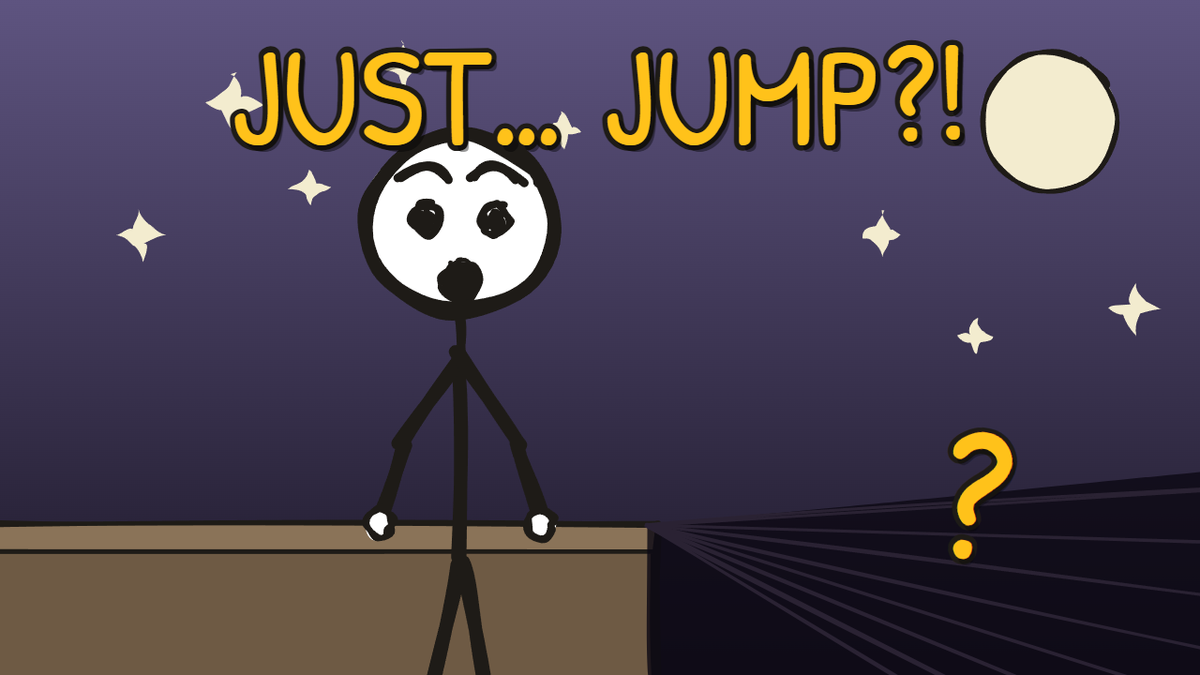
The animated version
Same answer, told as a little animated story with the strange little stickman acting it out. Dry, quick, and — obviously — correct.
▶ Video dropping soon — subscribe on YouTubeQuick questions
Is the call of the void normal?
Yes — it's remarkably common. In the first major study, over half of people with no history of suicidal thoughts reported having felt it at least once, and a 2020 German study found around 60% of an online sample recognised the feeling. It's a widespread quirk of a healthy brain, not a warning sign.
Does the urge to jump mean I'm suicidal?
Not on its own. Researchers found the urge is common in people who have never had suicidal thoughts, which is why the landmark study is titled 'An urge to jump affirms the urge to live.' It's generally read as the opposite of a death wish. That said, if such thoughts ever linger or distress you, it's genuinely worth talking to someone.
What is the call of the void called scientifically?
The clinical term is the high place phenomenon (HPP). The French phrase l'appel du vide — 'the call of the void' — is the popular name for the same experience.
Why does my brain tell me to jump when I don't want to?
The leading explanation is a misread signal. Your fast, subconscious brain fires an instant 'danger, step back' command as you near the edge, and you flinch before you consciously know why. Your slower conscious mind then notices the flinch and, arriving late, writes the wrong caption over it — 'did part of me want to jump?'
Who feels the call of the void the most?
Research links it to anxiety sensitivity — roughly, how tuned-in you are to your own bodily signals. People who notice every flutter of their heartbeat are better at hearing that internal alarm go off, and better at being startled by it.
Did anyone describe this before modern psychology?
Yes — in 1845, Edgar Allan Poe wrote an essay called 'The Imp of the Perverse' describing exactly this, including the urge on a precipice: 'because our reason violently deters us from the brink, therefore do we the most impetuously approach it.'
Our sources
// every claim on this page was checked before it went up