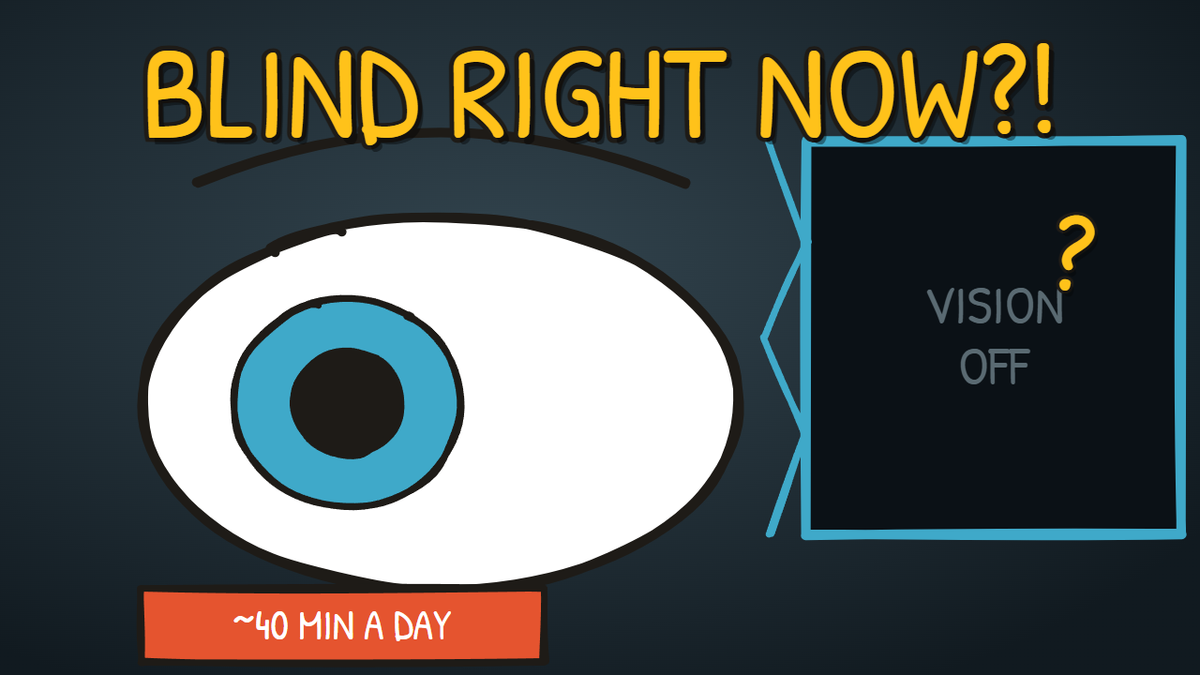
Here is something unsettling about the person reading this sentence: several times every second, you go completely blind. Not metaphorically — the visual signal genuinely cuts out. It's happening right now, as your eyes hop from word to word, and it has happened tens of thousands of times today already. You have never once noticed. That's not an accident. Your brain has spent your whole life covering it up, and it is astonishingly good at the job.
01 · The demoThe one thing everyone can see but you
Try this the next time you pass a mirror. Look at your left eye. Now look at your right eye. Now flick back and forth between them, as fast as you like. Here’s the strange part: you will never, ever catch your own eyes moving. They look perfectly still the entire time, as if teleporting from one to the other. But stand a friend beside you, ask them to watch your eyes, and they’ll see them darting back and forth without any trouble at all. So why can’t you see the one thing that’s plainly visible to everyone else in the room?
02 · The jumpYour eyes don't glide — they jump
Because your eyes don’t slide smoothly across the world the way it feels like they do. They move in tiny, violent jerks called saccades, and you make roughly three or four of them every second. They’re among the fastest movements your whole body is capable of — the largest can sweep at hundreds of degrees per second. And that speed is exactly the problem. If you actually saw the world during one of those flicks, the entire scene would smear sideways into a useless blur, like a photo taken while whipping the camera around.
03 · The shutdownSo the brain switches the lights off
To stop that, your brain does something genuinely drastic. Right around each jump, it turns your vision down — dropping your sensitivity so the smear never reaches conscious awareness. This is called saccadic masking, or saccadic suppression. For a sliver of time, several times a second, you are functionally blind. The lights go out while the eyes are in motion, and come back up once they’ve landed. Exactly how wide that blind window is depends on who you ask — estimates range from a few tens of milliseconds before the jump begins to around a hundred milliseconds after it ends — but the effect itself is not in doubt.
04 · The editThen it deletes the evidence
Switching the vision off would leave an obvious black gap — so the brain covers its tracks. It takes the clear, still image from just before the jump and the clear image from just after it, and quietly staples them together. The messy blurred bit in the middle is simply deleted, the way a film editor cuts the shaky footage between two clean shots. You never see the join, in exactly the way you never notice the cuts in a well-edited movie. Add up all those little blackouts across a day and the total is real, if hard to pin down — a much-repeated figure is around forty minutes, though that’s a back-of-envelope estimate rather than something a study has measured to the minute.
There's a way to catch your brain doing this red-handed — using nothing but a ticking clock — and once you've seen it, you can't unsee it.
05 · The glitchThe clock that stops
Find a clock with a ticking second hand. Look away from it, then quickly flick your eyes back. For a moment, that first tick will seem to hang — frozen, lasting far too long — before the ticking carries on at its normal pace. It has a name: chronostasis, the “stopped-clock illusion.” And it isn’t your imagination. To hide the blind gap while your eyes were flying toward the clock, your brain reaches back in time and paints over that blank with the very first clear image it gets of the clock — pretending you were already looking. That backdating stretches the first moment out and hands you a slice of time that never actually happened. When researchers measured this properly, people genuinely overestimated how long that first target had been in view; the size of the illusion even tracks how far the eyes had to jump.
06 · The tradeWhy the brain goes to all this trouble
So why bother with such an elaborate cover-up? Because the alternative is unbearable. A world that lurched and smeared every single time you so much as glanced across a room would be impossible to live in — dizzying, exhausting, unwatchable. So your brain strikes a bargain. It surrenders a few blind milliseconds, over and over and over, in exchange for a picture that stays smooth, and stable, and calm. A tiny constant white lie, told thousands of times a day, that keeps reality liveable.
07 · The payoffSo what are you actually looking at?
Which means the seamless, continuous, live world you feel like you’re watching right now isn’t live at all. It’s a highlight reel. The blackouts have been cut out, the gaps painted over, the whole thing smoothed into something that merely feels like unbroken reality. You are watching a beautifully edited film of the world, assembled in real time — and your own brain is the editor, quietly trimming the footage you were never meant to see. So the next time someone tells you to trust your own eyes, remember: your eyes are shut a good chunk of the day, and the director is filling in the rest. Enjoy the film.
The animated version
Same answer, told as a little animated story with the strange little stickman acting it out. Dry, quick, and — obviously — correct.
▶ Video dropping soon — subscribe on YouTubeQuick questions
Why can't I see my own eyes move in a mirror?
Because you go briefly blind every time they move. Flicking your gaze from one eye to the other is a saccade, and your brain suppresses vision during it — so there's nothing to see. A friend standing next to you isn't making that jump, so their vision stays on and they watch your eyes dart. It's the cleanest home demo of saccadic masking there is. (Curiously, a phone's front camera does let you see it, because its slight video delay shows your eyes only after they've stopped.)
What is saccadic masking?
It's the brain briefly shutting down visual processing around each rapid eye movement, so you never consciously see the motion blur that would otherwise smear across your retina. Sensitivity drops just before the jump begins and recovers shortly after it ends. It's why the world looks stable even though your eyes are lurching around it several times a second.
How much of the day am I actually blind?
You genuinely lose small slices of vision to every saccade, and they happen constantly, so the total is real but hard to pin down. A widely repeated figure is around 40 minutes of a waking day — but treat that as a rough popular estimate rather than a precise measured result. The exact number depends on how many saccades you make and how long you count each suppression as lasting.
What is chronostasis, the stopped-clock illusion?
When you flick your eyes to an analogue clock, the first tick of the second hand can seem to hang frozen for longer than a second before the ticking resumes. Your brain fills the blind gap during the eye movement with the first clear image it gets of the clock — effectively backdating that image — which stretches your sense of that first moment. It's the visible seam of the edit your brain is always making.
Why does the brain bother hiding it instead of just letting me see the blur?
Because a world that lurched and smeared every time you glanced around would be exhausting and disorienting. The brain trades a few blind milliseconds, over and over, for a picture that stays smooth and stable. A tiny constant white lie that keeps reality watchable.
Our sources
// every claim on this page was checked before it went up