You're lying in bed, warm, relaxed, just slipping over the edge into sleep. And then, out of nowhere, an enormous bang detonates inside your head. A gunshot. An explosion. Loud enough to jolt you bolt upright, heart slamming. You look around the dark room — and it is completely silent. Nothing fell. Nothing happened. The blast was entirely inside your skull. It sounds like the start of a horror film. It's actually a recognised, harmless, and surprisingly common thing that happens to healthy brains — and it has a genuinely magnificent name.
01 · The bangA real phenomenon with an unforgettable name
It’s called exploding head syndrome. And despite sounding like it belongs on a movie poster, it’s a real, recognised sensory parasomnia — a glitch tied to the sleep–wake transition. People describe a gunshot, a clash of cymbals, a slamming door, a crack of thunder, going off at full volume right as they drift off. There’s usually no pain at all. And crucially, there is no actual sound in the room. The explosion is manufactured entirely inside your own head.
02 · The companyFar more common than it sounds
Here’s the thing: if this has ever happened to you, you are in very good company. EHS is often treated as some rare oddity, but when researchers actually went and asked, they found it’s remarkably common. In one 2015 study of 211 university students, around one in five said they’d experienced it at least once, and about one in six had it recurrently. Later studies in other groups have reported even higher numbers. Huge numbers of people have quietly had their head “explode” at bedtime — and simply never mentioned it to anyone.
03 · The fearWhy people think they're dying
And the silence is part of what makes it so unnerving. When it happens, it is genuinely frightening — a violent bang inside your own head, in the dark, feels deeply wrong. So a lot of people leap straight to the worst thought. Is this a stroke? A tumour? Is something rupturing in my brain? And so they lie there, wide awake and terrified, convinced something is seriously wrong with them. That fear, it turns out, is the single most harmful thing about the whole experience.
04 · The reassuranceIt's completely harmless
So let’s clear that up straight away. As far as researchers can tell, exploding head syndrome is completely harmless. It isn’t a stroke. It isn’t a seizure. It doesn’t damage your brain, and it isn’t a warning sign of anything sinister. It is, essentially, a harmless glitch at the edge of sleep. It does turn up more often when your sleep is under strain — stress, sleep deprivation, an irregular schedule — but the only real damage it does is the fear itself.
05 · The shutdownHow your brain powers down at night
So what actually causes it? The leading idea is rather lovely. Think about what your brain has to do every single night. To fall asleep, it can’t just click off like a light switch — instead, a control centre down in your brainstem, the reticular formation, powers you down in stages. It quiets your muscles. Then it dims your vision. Then it hushes your hearing. Floor by floor, it shuts the building down for the night. Most nights, this happens so smoothly you never notice it at all.
In exploding head syndrome, the "hearing" floor blows a fuse on the way out. Instead of powering down quietly, that whole cluster of auditory neurons is thought to fire off all at once — one massive burst — and your half-asleep brain reads it the only way it knows how: as a deafening sound.
06 · The misfireThe bang made of nothing
That’s the leading explanation — and it’s worth being honest that it’s a leading idea, not a closed case. But it fits beautifully. Instead of the auditory neurons quietly going dark, they misfire a single, enormous burst of activity. Your brain, mid-shutdown, receives that huge jolt and interprets it as an enormous, deafening noise — a bomb made of nothing but a misfiring nerve. And occasionally the visual system throws the very same fault: instead of a bang, or along with it, some people report a sudden blinding flash of light behind the eyes. Same glitch, same misfire — just on the vision floor rather than the hearing one.
07 · The historyKnown for 150 years, still hushed up
And none of this is new. Doctors first described these night-time head explosions back in 1876, when the neurologist Silas Weir Mitchell wrote up patients experiencing what he called “sensory shocks.” It only got its gloriously blunt name — exploding head syndrome — in 1989, courtesy of the British neurologist John M. S. Pearce. And it’s still almost certainly under-reported, largely because the experience is so alarming and the name so absurd that people are simply too embarrassed, or too scared, to bring it up with anyone.
08 · The payoffJust a loose wire, settling for the night
So there’s something oddly comforting buried in all this. Every single night, your brain carefully powers itself down, stage by stage, room by room. And every so often, on the way out, one switch sticks, one circuit sparks, and you get a phantom explosion — a bomb made of nothing but a misfiring nerve. It isn’t a catastrophe, and it isn’t a warning. It’s just a loose wire in a very complicated machine, settling down for the night. Which is genuinely reassuring — right up until it happens to you at three in the morning, and leaves you bolt upright and completely awake, trying very hard to believe it.
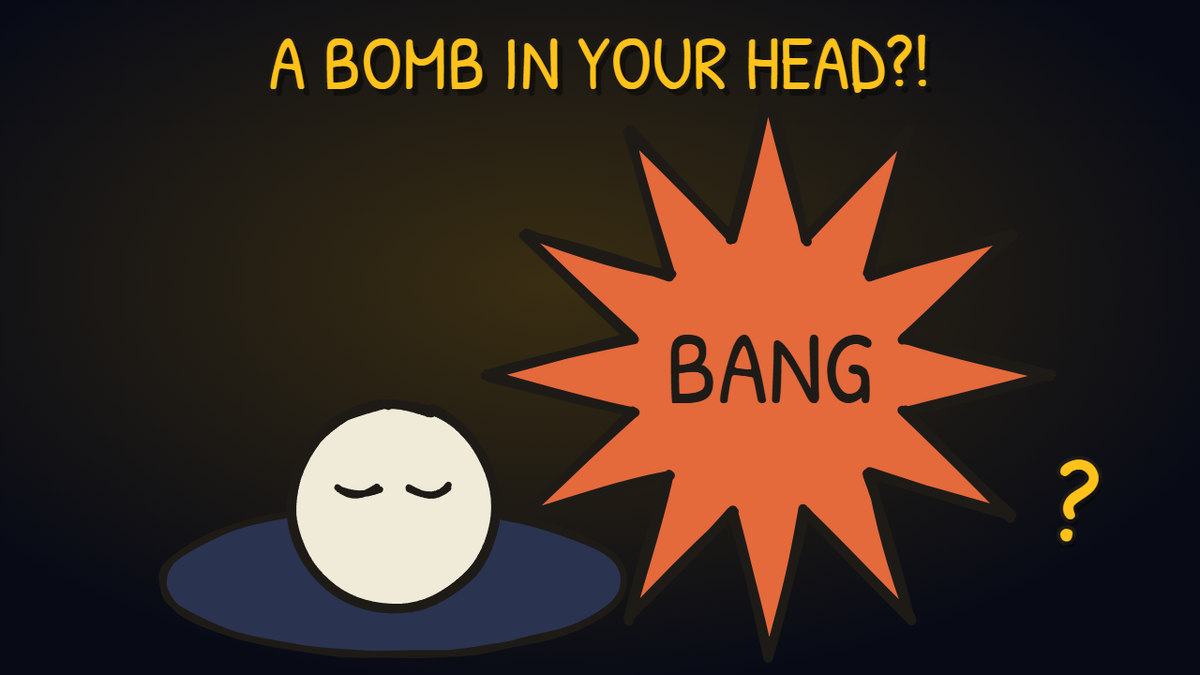
The animated version
Same answer, told as a little animated story with the strange little stickman acting it out. Dry, quick, and — obviously — correct.
▶ Video dropping soon — subscribe on YouTubeQuick questions
What is it called when you hear a loud bang as you fall asleep?
It's called exploding head syndrome (EHS) — a recognised sensory parasomnia. People experience a sudden, loud imagined noise — a bang, gunshot, cymbal crash or explosion — right at the transition into or out of sleep. It's usually painless, and there's no actual sound in the room.
Is exploding head syndrome dangerous?
As far as researchers can tell, no. It isn't a stroke, a seizure, a tumour or a sign of brain damage. It's essentially a harmless glitch at sleep onset. The real damage it does is the fear — the experience is frightening enough that people worry something is seriously wrong.
How common is exploding head syndrome?
More common than its rare-sounding reputation. In a 2015 study of 211 university students, about 18% had experienced it at least once, and roughly 16% had recurrent episodes — around 1 in 5. Later studies in other groups have reported even higher rates. Many people simply never mention it.
What causes exploding head syndrome?
The leading idea is a hiccup in the way your brain powers down for sleep. Normally a control centre in your brainstem quiets your neurons in sequence — motor, then visual, then auditory. In EHS the auditory neurons are thought to misfire a single burst all at once instead of going quiet, and your half-asleep brain interprets it as a loud sound. It's the leading explanation, not a proven fact.
Can exploding head syndrome cause a flash of light instead of a bang?
Yes. Some people report a sudden flash of light behind the eyes, instead of — or along with — the bang. It's thought to be the same kind of misfire, just on the visual system instead of the auditory one.
Our sources
// every claim on this page was checked before it went up