You see a puppy. An impossibly, ludicrously cute puppy. And out of nowhere, through gritted teeth, you hear yourself growl: I just want to squeeze it. But you don't want to hurt it — the very idea is horrifying. So why does something so unbearably adorable make you want to crush it? The answer turns out to be one of the strangest things your brain does to protect you from your own feelings.
01 · You're normalIt has a name, and most people feel it
First, the good news: you are completely normal. This has a name — cute aggression — and estimates put it at somewhere between about half and 60% of adults. It’s common enough that other languages beat English to a word for it: the Filipino gigil, which captures exactly that clench-your-fists, grit-your-teeth urge toward something adorable. It’s so useful a concept that the Oxford English Dictionary formally adopted gigil in 2025. And far from being a warning sign, it may actually be your brain quietly protecting you from being overwhelmed.
02 · The baby schemaWhy "cute" grabs you so hard
Start with why cuteness has such a grip in the first place. Big eyes, a big round head, chubby cheeks, a tiny little nose. Ethologist Konrad Lorenz called this the baby schema — a checklist of infant-like features that automatically switches on your caregiving instincts. It evolved to make you adore and protect helpless human infants, whose survival depends entirely on adults finding them irresistible. The catch is that your brain isn’t remotely fussy about the source: a puppy, a kitten, a cartoon character with a big enough head all tick every box and hijack the exact same circuit. Brain scans back this up — those baby-schema features light up the reward system, the same machinery tied to other things we crave.
03 · Too much of a good thingThe flood
And when something hits that checklist hard enough, the reward centres don’t just switch on — they flood. You get a surge of warmth and wanting so intense it starts to become a problem. It is, genuinely, too much of a good thing: a wave of pure tenderness powerful enough to completely overwhelm you. Which raises an obvious question — what does a nervous system actually do with a positive feeling that big?
04 · The wrong maskOne emotion, dressed as its opposite
Here’s the beautiful trick humans use. When a positive feeling grows overwhelming, we very often express it as its exact opposite. We cry at weddings, when we’re happy. We burst out laughing at the most nervous, least appropriate moment imaginable. And we look at the single sweetest thing we’ve ever seen — and want to squeeze it to bits. In 2015, a Yale psychologist named Oriana Aragón gave this pattern a name: a dimorphous expression. One emotion, wearing completely the wrong mask. Her key proposal was that these mismatched expressions aren’t random noise — they’re doing a job. They help regulate an emotion that’s grown too strong.
The aggressive urge isn't the opposite of the tenderness. In brain recordings, it turns out to be the tenderness — with the emotion-regulation system slamming on the brakes.
05 · The brakeWhat scientists watched happen
In 2018, researchers Katherine Stavropoulos and Laura Alba put 54 people in EEG caps and actually watched cute aggression play out. When it struck, two systems engaged at once: the reward system, lit up by all that cuteness, and the brain’s emotion-regulation machinery. The stronger someone’s reported urge to squeeze, the more this showed up in their reward-related brain activity. So the aggressive little urge isn’t a competing feeling fighting the tenderness — it’s the brake on it. Your brain throws in a jolt of something fierce precisely to drag an overwhelming high back down to a level you can actually handle.
06 · Why the brake mattersSo you don't seize up
That braking might be the entire point. Picture being so completely melted by a baby’s cuteness that you simply seize up — useless, incapacitated, no good to anyone. For a creature whose whole job is to care for that baby, that’s a genuine disaster. So the snarl, the gritted teeth, the urge to squeeze snap you out of the trance and back into a state where you can actually function and look after the tiny thing you adore. It’s worth being honest that this regulatory story is still the leading hypothesis, not a closed case — but it fits the brain data well, and it makes evolutionary sense.
07 · The payoffThe strangest love language there is
So cute aggression is, weirdly, one of the strangest love languages going. It isn’t a glitch, and it certainly isn’t a dark urge. It’s your brain so completely flooded with care and tenderness that it has to fake a snarl just to keep you upright and useful. Those gritted teeth aren’t the opposite of how much you adore something — they’re the overflow. So the next time a kitten is so impossibly soft that you want to bite its tiny face, don’t panic. That’s not menace; that’s just your heart working slightly too hard. Although — for absolutely everyone’s sake — maybe still don’t actually bite it.
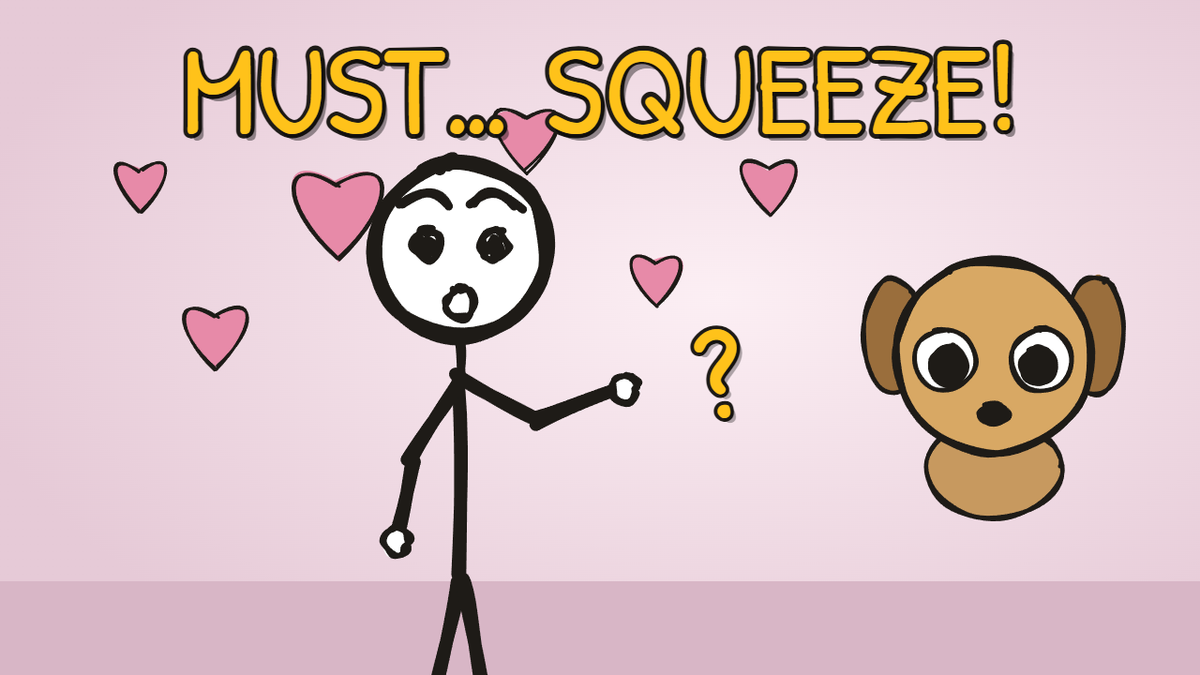
The animated version
Same answer, told as a little animated story with the strange little stickman acting it out. Dry, quick, and — obviously — correct.
▶ Video dropping soon — subscribe on YouTubeQuick questions
What is cute aggression?
It's the urge to squeeze, pinch, bite or "crush" something extremely cute — a puppy, a baby — despite having absolutely no desire to hurt it. It was named by researchers at Yale, and estimates suggest somewhere between about half and 60% of adults feel it.
Is cute aggression normal?
Completely. It's common enough that many languages have their own word for it — the Filipino gigil, which the Oxford English Dictionary formally added in 2025. Far from a warning sign, the leading view is that it's your brain regulating an overwhelming positive emotion so you can keep functioning.
Why do cute things trigger it?
Cuteness works through the baby schema — a set of infant-like features (large eyes, a big round head, chubby cheeks, a small nose) that Konrad Lorenz argued automatically switches on caregiving. Puppies and kittens tick the same boxes and hijack the identical circuit, and the more intense the cuteness, the stronger the response.
What is a dimorphous expression?
It's when one emotion is expressed as its apparent opposite. Yale's Oriana Aragón named the concept in 2015: crying tears of joy, nervous laughter, or wanting to squeeze something you adore. The theory is that these mismatched expressions help regulate emotions that have grown too intense.
Does wanting to squeeze cute things mean something is wrong with me?
No. Brain-recording work suggests the aggressive urge is a regulatory brake — a jolt of something fierce that pulls an overwhelming high back to a manageable level. It's less a dark impulse and more your caregiving system running slightly too hot.
Our sources
// every claim on this page was checked before it went up