You've been in the bath a while, you look down at your fingertips, and there they are: all pruney and wrinkled, like tiny raisins. And you already know why, right? The skin soaked up the water and swelled. Simple, obvious, and — as it happens — completely wrong. The real reason is one of the strangest little tricks your body pulls, and there's a jaw-dropping way to prove it: your body isn't reacting to the water. It's choosing to wrinkle.
01 · The obvious answerWhy "it just swells up" feels so right
Start with the swelling idea, because it’s so intuitive. Water soaks into the dead outer layer of skin on your fingertips, the skin puffs up, runs out of room, and buckles into wrinkles. Tidy. Sensible. The kind of explanation you’d happily give a child. There’s just one clue that blows the whole thing apart — and it was spotted almost a century ago.
02 · The clue that cracks itCut the nerve, and the wrinkling stops
Back in the 1930s, doctors noticed something extraordinary. If a person had damaged a particular nerve running to their hand, that finger could sit in water all day and never wrinkle at all. Same water. Same skin. But sever the nerve, and the wrinkling simply switches off. Now sit with that for a second. If this were just water soaking into dead skin, a damaged nerve would make no difference whatsoever — the water doesn’t care about your nerves. Which means the wrinkling isn’t something happening to your fingers. Your fingers are doing it.
03 · The real causeAn active reflex, run without asking you
This is an active process, run by your nervous system — specifically the autonomic nervous system, the same automatic pilot that runs your heartbeat and your breathing without ever checking in first. Your fingertips detect that they’ve been submerged, and they respond, on purpose. The effect is now used the other way round, too: because it needs working nerves, doctors use the presence or absence of finger wrinkling as a quick “wrinkle test” of whether the sympathetic nerves are firing — a genuinely useful bedside trick born from a bath-time curiosity.
04 · The mechanismWhat's actually happening down there
Here’s the sequence. Water seeps in through the tiny sweat ducts in your fingertips and upsets the balance of salts just under the surface. That shift triggers the sympathetic nerves to fire, and they tell the blood vessels beneath the skin to clench tightly shut. As those vessels constrict, the tissue underneath loses volume and the upper layers of skin get pulled downward from the inside. And because that skin is tacked down at certain points, it can’t sink evenly — it puckers into ridges and valleys. That’s your wrinkle. Note what the culprit is: the vessels shrinking, not the skin swelling. It’s the opposite of what everyone assumes.
05 · The rain treadsWhy it looks a bit designed
Here’s the detail that makes it feel intentional: the wrinkles aren’t random. The same finger tends to make the very same pattern every single time. The neuroscientist Mark Changizi looked at those channels in 2011 and saw something familiar — they branch and drain, he argued, exactly like the tread on a car tyre, or the network of rivers running off a mountain. The idea, which he called the “rain-tread” hypothesis, is that the wrinkles carve little channels to squeeze water out from under your fingertip so the skin can grip. Rain treads for your hands.
The mechanism — nerves, not swelling — is rock solid. But the reason it evolved is still an open fight. One study says wrinkles help you grip wet things; the next says they do nothing at all.
06 · The grip debateWhere the science genuinely argues
In 2013, researchers at Newcastle University put the rain-tread idea to the test. They had people move wet marbles and weights from one tub to another — first with smooth fingers, then with wrinkled ones — and found people were reliably faster with the wet objects when wrinkled, by around 12%, with no difference at all for dry objects. Lovely, clean result. Then, in 2014, a different lab tried to repeat it with 40 volunteers and found no benefit to grip or touch, and couldn’t reproduce the effect. A larger 2021 study swung back toward a grip advantage. So the honest state of play is this: the plumbing is settled, but the purpose is not. It’s a genuine, live scientific argument — which is far more interesting than a tidy answer.
07 · The payoffSo what are pruney fingers, really?
Look at how the whole thing behaves and the picture snaps into focus. It only kicks in when your fingers are actually wet. It takes several minutes to appear, and once your hands dry off, it quietly smooths itself away. That is not what a passive accident looks like — that looks a lot like a feature switching on precisely when it might be needed. So your pruney bath fingers aren’t a sign of soggy, waterlogged skin. They’re closer to the opposite: a piece of built-in wet-weather gear, actively deployed by your nervous system the moment things turn slippery. Little tyre treads, rolled out on demand — for a bath.
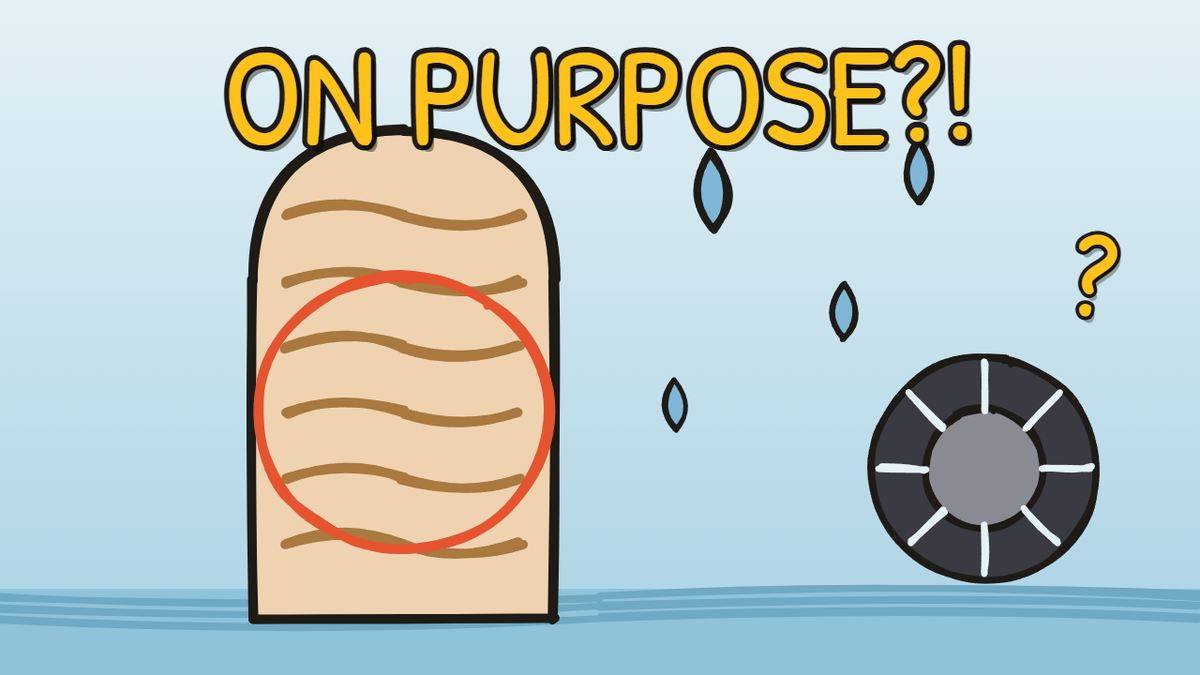
The animated version
Same answer, told as a little animated story with the strange little stickman acting it out. Dry, quick, and — obviously — correct.
▶ Video dropping soon — subscribe on YouTubeQuick questions
Why do fingers wrinkle in water if it's not the skin swelling?
Because it's an active nerve reflex, not passive soaking. When your fingertips are submerged, sympathetic nerves signal the blood vessels just beneath the skin to constrict. As they shrink, they pull the tacked-down skin inward, buckling it into ridges. Osmosis alone would happen even without working nerves — and it doesn't.
How do we know finger wrinkling isn't just water soaking in?
The clearest proof comes from nerve damage. In the 1930s, doctors noticed that a finger served by a damaged nerve won't wrinkle in water at all — same water, same skin, no wrinkles. If it were simple soaking, the nerve would make no difference. It makes all the difference.
Is finger wrinkling in water used as a medical test?
Yes. Because intact sympathetic nerves are needed for it, the presence or absence of finger wrinkling is used as a simple bedside "wrinkle test" of nerve function — handy for checking nerve injury, including in children or patients who can't cooperate with other tests.
Do wrinkled fingers actually help you grip?
Maybe — it's the leading theory but not settled. A 2013 Newcastle University study found people moved wet objects about 12% faster with wrinkled fingers, and no faster with dry ones. But a 2014 study of 40 people found no benefit and couldn't reproduce it. The mechanism (nerves) is solid; the evolutionary purpose is still argued.
Why do fingers take a while to wrinkle and then un-wrinkle?
Because it's a controlled response, not instant absorption. It typically takes several minutes of immersion to appear and reverses once your hands are dry (roughly 10–20 minutes in one study). A passive soaking effect wouldn't switch itself on and off like that.
Our sources
// every claim on this page was checked before it went up