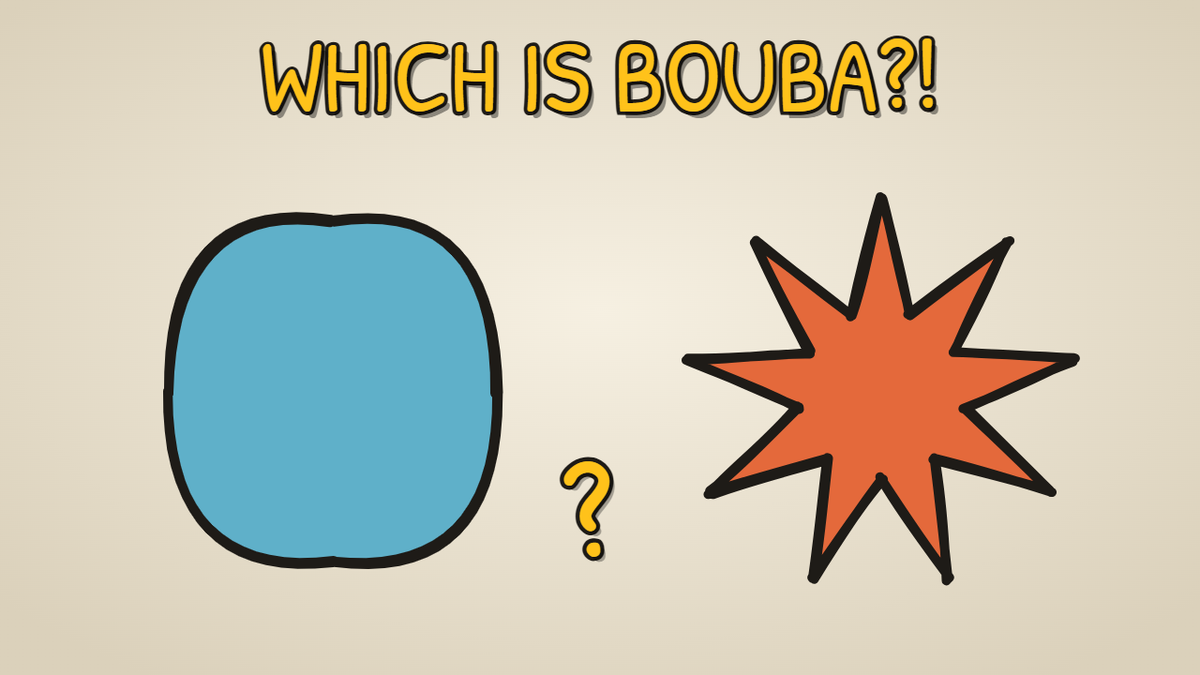
Here are two shapes. One is soft, round and blobby, like a puddle mid-yawn. The other is sharp and jagged, all spikes and points. Now, in some made-up language, one of them is called bouba and the other is called kiki. Point at the bouba. You did it instantly, didn't you — and you almost certainly picked the round one. The strange part isn't that you have an opinion. It's that nearly everyone on the planet has the same one.
01 · The testYou just agreed with almost everyone alive
Calling the round blob “kiki” feels faintly wrong, like the word and the shape are grinding against each other. And this isn’t a gentle lean or a coin-flip. When researchers run this test, the round-goes-with-bouba answer comes back with startling force — the figure most often quoted from the study that made it famous is about 95%. For a species that can’t agree on pizza toppings, that is about as close to unanimous as we ever get.
The obvious first suspicion is that it’s a trick of English, or of the alphabet — maybe a “b” just looks round and a “k” looks pointy. It isn’t that. And we know, because the same people who can’t read at all still feel it.
02 · The historyA hundred-year-old party trick
This is not some new bit of internet folklore. Back in 1929, the Gestalt psychologist Wolfgang Köhler showed people a rounded shape and a spiky one and asked which was maluma and which was takete. Same result: round was maluma, spiky was takete. The words were rebranded to the catchier bouba and kiki by neuroscientists V.S. Ramachandran and Edward Hubbard in 2001, and it’s those two that stuck. So for the best part of a century, people have looked at these shapes and quietly reached the same verdict.
03 · The reachAcross languages and alphabets
The real test is whether it survives outside English. In 2022 a team led by Aleksandra Ćwiek ran the experiment on around 900 people speaking 25 different languages — nine language families, ten separate writing systems, from Japanese to Zulu to Swedish. The effect held in 17 of the 25 languages, with agreement averaging comfortably over 70%. Crucially, speakers of alphabets with rounder-looking letters weren’t any more likely to feel it, which rules out the “the b just looks round” explanation.
Now, honesty compels a footnote: it wasn’t every single language. A handful — Mandarin, Turkish, Romanian and Albanian among them — didn’t show it cleanly. So the fair phrasing isn’t “everyone, everywhere.” It’s almost everyone, almost everywhere — which, for a gut reaction to two nonsense words, is still astonishing.
04 · The childrenToo young to read, old enough to feel it
Here’s where the “it’s just the alphabet” idea collapses for good. In 2006, Daphne Maurer and colleagues ran the test on toddlers of about 2.5 — children who can barely talk, let alone read a single letter. They matched the rounded sounds to the rounded shapes exactly the way adults did. Some later work even finds sound–shape biases in four-month-old infants. So whatever this is, school didn’t teach it to you. It’s sitting far deeper than that — closer to how your senses are wired than to anything you were told.
05 · The mechanismThe sound has a shape in your mouth
So what’s actually going on? The leading idea is beautifully physical. Say “bouba” slowly and pay attention to your face: your lips push out into a soft, round shape, and the sound rolls out smooth and continuous. Now say “kiki.” Your tongue snaps sharply against the roof of your mouth, chopping the sound into hard, spiky little bursts. The sound literally has a shape — in the movement of your mouth and in the jaggedness of the acoustics.
And your brain, it turns out, is forever cross-matching qualities across the senses. A soft, rounded, rolling sound gets quietly filed alongside soft, rounded, rolling shapes; a hard, sharp, jagged sound gets filed with hard, sharp, jagged ones. This is called cross-modal correspondence, and it’s why a spiky sound and a spiky shape feel like they belong together — because in your brain, in a real sense, they already do. (The exact machinery is still argued over, so hold this as the best current story rather than the final word.)
We're taught as a hard rule that language is arbitrary — that a word's sound has nothing to do with its meaning, that "cat" could just as easily have been "dog." Bouba and kiki whisper back: well, not entirely.
06 · The bigger questionA possible seed for the first words
That footnote — that sound and meaning aren’t fully arbitrary — opens onto a genuinely large question. If certain sounds naturally feel soft and others naturally feel sharp, to nearly everyone, then this shared instinct could have handed our distant ancestors a foothold. A way to start attaching noises to things that any listener could simply feel was right, without anyone having to agree on it first. Some researchers call this the sound-symbolism bootstrapping idea: iconic, feelable sound–meaning links may have given early language a place to grab hold, both in babies learning to talk and, further back, in the emergence of words themselves.
It’s still debated, and nobody is claiming your whole vocabulary works this way. But it’s a lovely thought — that the first words might have been less invented than recognised.
07 · The payoffSo why does everyone agree?
Because you’re not really choosing at all. When you point at the round blob and call it bouba, you’re not exercising taste — you’re reporting the output of a very old wiring job, one that quietly links the shape of a sound in your mouth to the shape of a thing in your eye. It runs before school, before reading, in nearly every language on Earth, and it feels less like an opinion than a fact you’re simply noticing. The next time a word just sounds soft, or sharp, or round, or pointy, that’s not you being fanciful. That’s an instinct older than reading, shared across almost everyone alive, agreeing with you — and with them.
The animated version
Same answer, told as a little animated story with the strange little stickman acting it out. Dry, quick, and — obviously — correct.
▶ Video dropping soon — subscribe on YouTubeQuick questions
What is the bouba/kiki effect?
It's the near-universal tendency to match the made-up word bouba to a soft, round shape and kiki to a sharp, spiky one. It's a classic example of sound symbolism — the idea that some speech sounds carry a built-in 'feel' that isn't arbitrary.
Who discovered the bouba/kiki effect?
The psychologist Wolfgang Köhler first demonstrated it in 1929, using the words maluma (round) and takete (spiky). The neuroscientists V.S. Ramachandran and Edward Hubbard revived it in 2001 with the now-famous bouba and kiki.
Is the bouba/kiki effect universal across all languages?
It's remarkably widespread but not literally universal. A 2022 study across 25 languages and 10 writing systems found it in 17 of them; a handful — including Mandarin, Turkish, Romanian and Albanian — didn't show it clearly. So 'almost everyone, almost everywhere' is the honest phrasing.
Why does 'bouba' feel round and 'kiki' feel spiky?
Say them slowly. Bouba pushes your lips into a soft, rounded shape and the sound rolls out smooth and continuous. Kiki snaps your tongue sharply against the roof of your mouth, chopping the sound into hard little bursts. The sound has a shape in your mouth, and your brain matches it to the shape you see.
Do children show the bouba/kiki effect?
Yes — and strikingly early. Toddlers around 2.5 years old, well before they can read, already match the round sounds to round shapes just like adults. Some studies even find sound-shape biases in four-month-old infants.
What does bouba/kiki tell us about language?
It challenges the textbook rule that word sounds have nothing to do with meaning. If some sounds reliably 'feel' round or sharp to almost everyone, those shared instincts may have given our ancestors a foothold for attaching sounds to things — a possible seed for the first words. That part is still debated.
Our sources
// every claim on this page was checked before it went up