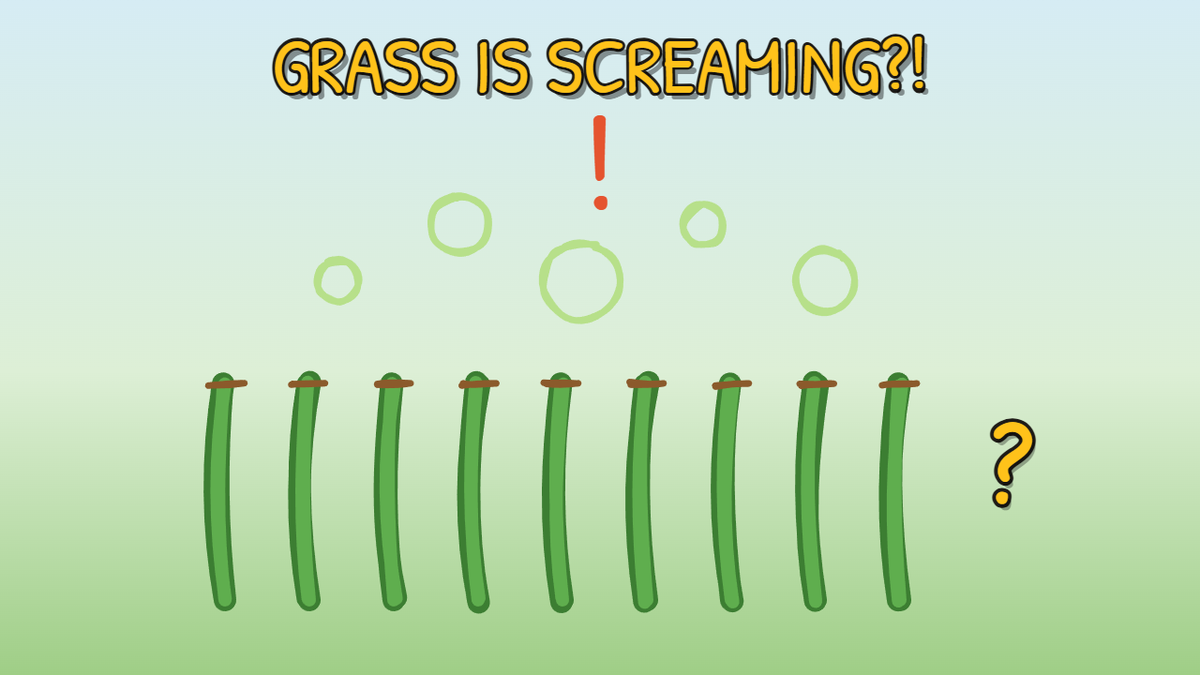
Is there a better smell in the world than a freshly-mown lawn on a warm day? It's the smell of summer — of long holidays, of sport, of childhood. It just makes you feel good, somewhere deep in your bones. It is, without much doubt, one of nature's loveliest scents. And it is also, it turns out, one of its most sinister. Because that smell isn't a perfume the grass gives off because it's happy. It's the grass screaming.
01 · The chemistryIt isn't a smell — it's a chemical cloud
Start with what the smell actually is. It isn’t some vague essence of “green.” It’s a specific cloud of tiny, light molecules that grass and most other green plants puff into the air, and scientists have a name for them: green leaf volatiles. The star of the group is a compound called cis-3-hexenal — the pure, sharp “cut grass” note — which our noses are absurdly sensitive to, picking it up at a fraction of a part per billion. When you smell a mown lawn, those molecules are what’s drifting up your nose. Which raises the real question: why does the grass bother making them at all?
02 · The timingReleased in seconds — but only when cut
The first clue is the timing. Grass doesn’t sit there gently perfuming the air all day. It releases the cloud in a sudden burst, within seconds, the instant a blade is sliced. Cut it, and enzymes inside the wounded plant immediately start dismantling its own cell membranes — the lipoxygenase pathway — and converting those membrane fats into airborne compounds almost instantly. It’s fast because it’s a reaction to damage, not a leisurely bit of housekeeping. The trigger is injury, and the response is nearly immediate.
03 · The woundThe smell of a plant being injured
And that’s the crucial part. This whole process only fires when the plant is damaged — cut, torn, crushed, or bitten. In other words, the beautiful smell of fresh-cut grass is, very specifically, the smell of a plant being wounded. It’s a wound response, the botanical equivalent of a yelp. Once you know that, the scent quietly changes character. It stops being a summer perfume and starts being something else entirely: an alarm. And an alarm, it turns out, with a very deliberate purpose.
That gorgeous smell is a distress call. The wounded grass is flooding the air with a chemical scream — and it's aimed at two very different audiences at once.
04 · The warningPlants talking to plants
The first audience is the neighbours. Plants growing nearby can detect these volatiles drifting over, and they treat the signal as an early warning: danger is here. In response, they begin switching on their own defence-related genes — pre-loading chemical defences, getting ready to make themselves tougher and less palatable — before anything has so much as touched them. It’s genuinely plants preparing plants, through the air. Not conversation in any intentional sense, but a broadcast that changes the behaviour of everything downwind.
05 · The bodyguardsA dinner bell for the enemy's enemy
The second audience is far more cunning. That same cloud of chemicals is also a call for reinforcements. Certain predators — parasitic wasps and other insects that hunt the very caterpillars and bugs chewing on the plant — can smell this distress signal too. And to them, it’s a dinner bell. Experiments have shown that boosting a plant’s green-leaf-volatile output makes it markedly more attractive to parasitic wasps, which then hunt down the herbivores. The wounded plant is, in effect, screaming: help — come and eat whatever is eating me. And the bodyguards come running.
06 · The weaponSome of it is a spray, not a message
On top of all that, some of these volatiles aren’t just messages — they’re weapons in their own right. A number of them are directly off-putting or even mildly toxic to insects, and several have real antimicrobial punch, inhibiting bacteria and fungi that might infect the fresh wound. So the same single burst is doing three jobs simultaneously: it’s a warning to the neighbours, a distress call to the bodyguards, and a chemical spray at the attacker. For something with no brain, no muscles and no way to run, that’s a remarkably complete emergency response.
07 · The payoffSo why does a scream smell so lovely?
Which leaves the delightful mystery: why does a plant’s cry of agony smell so wonderful to us? Almost certainly because our brains read it completely differently. To a human, that green, fresh scent reads as lush growth, healthy plants, a living landscape full of potential — and for most of us it’s soaked in summer nostalgia besides. Some research on plant and nature scents even hints at a mild calming effect, though how much is the molecules and how much is the memory isn’t settled. So here’s the real picture: run a mower across your lawn on a summer afternoon, and what you’re actually standing in is a whole field of tiny green creatures, all screaming at once — warning each other, calling in air support — while you breathe deeply and sigh with pure contentment. Enjoy it. It’s the sweet, sweet scent of a thousand tiny screams. Mow responsibly.
The animated version
Same answer, told as a little animated story with the strange little stickman acting it out. Dry, quick, and — obviously — correct.
▶ Video dropping soon — subscribe on YouTubeQuick questions
What actually makes fresh-cut grass smell that way?
A group of chemicals called green leaf volatiles — six-carbon aldehydes, alcohols and esters. The dominant note is cis-3-hexenal, which humans can smell at astonishingly low concentrations. Those molecules drift up your nose and register as 'fresh cut grass.'
Why does grass only smell like that when it's cut?
Because the smell is a wound response. Cutting or crushing the blade ruptures cells and triggers the lipoxygenase enzyme pathway, which breaks membrane fats into airborne volatiles within seconds. Undamaged grass doesn't release the burst — the scent is specifically the smell of injury.
Is the smell of cut grass really a distress signal?
Yes. The volatiles work as a defence and alarm: they prime neighbouring plants to prepare their own defences, and they attract predators and parasitic wasps that attack the insects feeding on the plant. It's a genuine chemical cry for help — we just find it pleasant.
Can plants really warn each other through the air?
In effect, yes. Neighbouring plants detect drifting green leaf volatiles and respond by switching on defence-related genes, so they're partly pre-armed before any pest reaches them. It isn't communication in an intentional sense, but the airborne signal does change how nearby plants behave.
Why do humans find it so pleasant if it's a distress call?
We almost certainly read it differently: a green, fresh scent signals healthy growth and a living landscape, and for many people it's laced with summer nostalgia. Some research on plant and nature scents also points to mild calming effects — though how much is down to the molecules themselves versus memory is not settled.
Our sources
// every claim on this page was checked before it went up