You know the exact moment. The music is building, a voice climbs higher, a chord suddenly opens up — and a wave of goosebumps sweeps down your neck, your arms, your spine. It can feel almost overwhelming, like being physically moved. And yet absolutely nothing has touched you. It's just air, vibrating. So why does your body react as though something enormous just happened?
01 · The nameIt's called frisson — and not everyone gets it
The shiver has a name: frisson, sometimes dressed up as “aesthetic chills.” And it’s strangely divisive. Depending on the study, somewhere between about half and three-quarters of people report feeling it — estimates run roughly from 55% to 86%, which is a wide range and a sign the science is still pinning down the exact number. Either way, it means there’s a genuine group of people who never feel a thing, and are quietly baffled that the rest of us do. If you’re one of those people, hold on — there’s a decent theory for why.
02 · The reflexThose shivers are literally goosebumps
Here’s the first oddity. Those chills aren’t a metaphor — they’re literally goosebumps. Tiny muscles at the base of each hair, yanking it upright. And that’s an ancient survival reflex: the same one that puffs a frightened cat up to look bigger, and the one that traps a layer of warm air against your skin when you’re cold. Which is genuinely strange when you stop to think about it. Why on earth would a beautiful piece of music trigger a reflex built for fear and cold? A lovely melody is neither threatening you nor freezing you. And yet your skin responds as if it were.
03 · The hijackMusic sneaks into your reward system
The answer is that music slips into one of your oldest circuits: reward. Whenever you do something good for survival — eating when you’re starving, say — your brain pays you in dopamine, the very same chemical behind craving, and sex, and addictive drugs. It’s the machinery that makes survival feel good so you’ll do it again. And somehow, patterns of pure sound plug directly into that ancient reward circuit, no survival value attached. Music tricks a system built for food and safety into firing over an arrangement of notes.
In 2011, scientists scanned people's brains at the precise instant the chills struck — and watched dopamine come flooding out in two separate waves. One as the music built, in pure anticipation. Then a second, bigger surge at the emotional peak itself.
04 · The scanDopamine, caught in two waves
That landmark study is worth sitting with. Using brain imaging that could track dopamine directly, researchers found the chemical wasn’t released just once, at the payoff. It came in two anatomically distinct waves. First, a release in the anticipation phase — as the music built toward a peak the listener could feel coming. Then a second, larger surge at the peak itself, the exact moment the chills landed. A 2013 follow-up drove the point home: activity in the brain’s core reward hub predicted how much money people were willing to pay for music they’d never heard before. Your brain treats a great song as something genuinely worth having.
05 · The gapHalf the pleasure is in the wanting
And that first wave — the anticipation — is the secret. Your brain is a relentless prediction machine, always guessing the next note before it arrives. So when a piece of music promises a resolution, teases it, holds it back, and then finally delivers, the payoff lands far harder than a simple, predictable line ever could. Frisson lives right there, in the gap between expectation and surprise — a build-up that’s honoured, or a swerve that turns out, in hindsight, to be exactly right. This is the leading account rather than the whole story, but it explains why the same predictable pop hook can thrill you the first week and leave you cold the tenth.
06 · The wiringWhy some people never feel it
So why do some people never get a single shiver? The leading idea is simply wiring. Brain scans suggest that people who feel frisson have denser connections between the hearing part of their brain and its emotional and reward regions — literally more “cable” running between sound and feeling. If those bridges are thinner, the music may reach the ear but never quite reach the switch. It’s a compelling finding, though it comes from relatively small studies, so it’s best read as the strongest current explanation rather than a settled fact. Some people simply aren’t wired to be moved by sound in this particular, physical way — and that’s not a flaw, just a different set of connections.
07 · The payoffSo why does music give you chills?
It isn’t only music, by the way. A breathtaking view, a single perfect line in a film, a wave of awe, even a beautiful idea clicking into place — all can set off the same shiver. Frisson is really your reward system standing up and saluting something it finds profoundly, movingly right.
So your goosebumps at a piece of music aren’t a glitch. They’re the same reflex that once braced your ancestors against a charging predator or a bitter wind — now firing for something with no survival value whatsoever. A melody. Your body, moved so deeply by pure pattern that it braces as if something enormous just happened. Because, as far as your brain is concerned, something did.
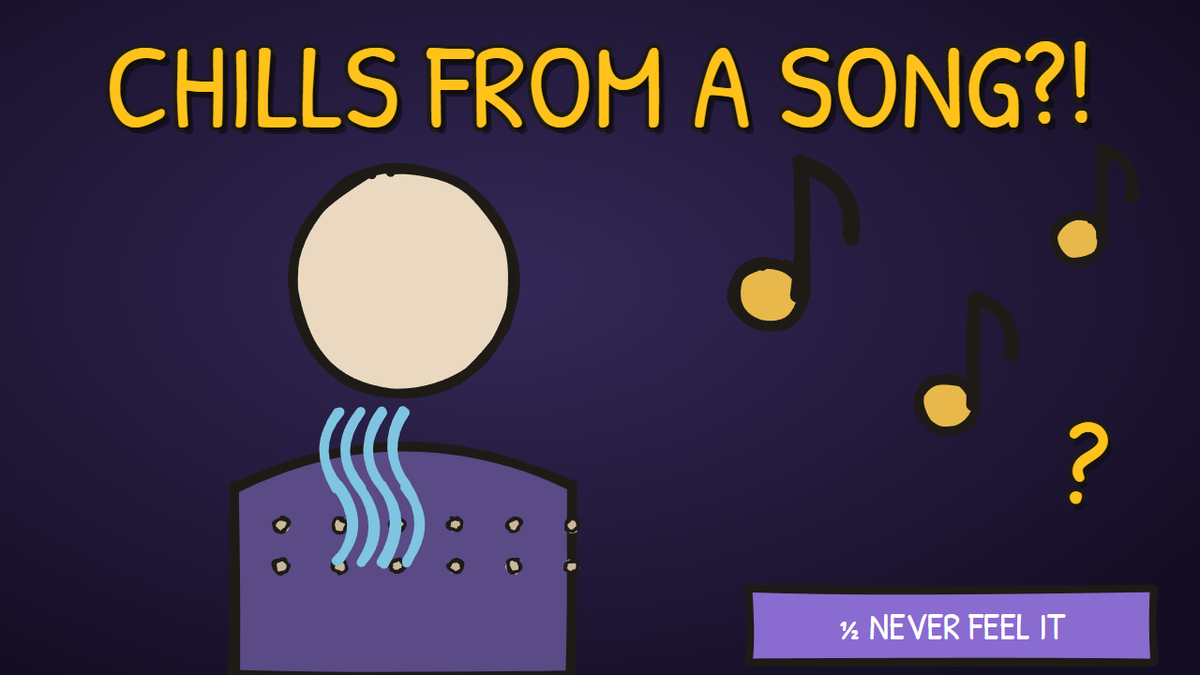
The animated version
Same answer, told as a little animated story with the strange little stickman acting it out. Dry, quick, and — obviously — correct.
▶ Video dropping soon — subscribe on YouTubeQuick questions
Why does music give you chills?
Because certain moments in music plug into your brain's reward system and release dopamine — the same chemical tied to food, sex and drugs. That jolt of reward at an emotional peak sets off goosebumps, a reflex normally reserved for cold and fear. The chills are your body reacting to pure sound as if something important just happened.
What is frisson?
Frisson is the technical name for the wave of goosebumps and shivers people feel at an aesthetic peak — a soaring voice, a key change, a swelling chorus. It's sometimes called 'aesthetic chills' or, more colourfully, a 'skin orgasm.' Roughly 55–86% of people report feeling it, depending on the study.
Why do some people never get chills from music?
The leading idea is brain wiring. Brain-imaging work suggests people who feel frisson have denser white-matter connections between the hearing part of the brain and its emotional and reward regions — more 'cable' between sound and feeling. If those connections are thinner, the music may simply never reach the switch. This is a promising finding from small samples, so treat it as the best current explanation rather than the final word.
Why do goosebumps happen for a happy song?
Because goosebumps aren't really about the emotion — they're a general 'something significant is happening' alarm, driven by your reward and arousal systems. A powerful piece of music trips that alarm just like cold or fear would. The reflex is the same; only the trigger is different.
Can things other than music give you frisson?
Yes. A breathtaking view, a perfect line in a film, a wave of awe, even a beautiful idea clicking into place — all can set off the same shiver. Frisson is really your reward system saluting anything it finds profoundly, movingly right.
Our sources
// every claim on this page was checked before it went up