It is one of the most reliable little catastrophes in daily life. You brush your teeth, feeling fresh and clean, and then — without thinking — take a big swig of orange juice. And it is genuinely revolting. Bitter, sour, weirdly metallic, and just wrong. It happens so consistently that it feels like a law of nature. And almost everyone blames the same innocent bystander: the mint.
01 · The suspectThe mint didn't do it
The obvious theory is that leftover mintiness clashes with sweet orange, and the two flavours fight to a horrible draw. It sounds sensible. It’s also wrong. The giveaway is that you get the exact same disaster with a completely flavourless toothpaste — no mint anywhere in sight. So whatever is wrecking your juice, it isn’t the taste of the toothpaste at all. It’s an ingredient you never actually taste.
02 · The culpritA detergent called SLS
Most toothpastes contain a chemical called sodium lauryl sulfate, or SLS. It’s a surfactant — a detergent — and it’s the thing that makes your toothpaste foam up into all those satisfying bubbles. That foaming is not just for show; it helps spread the paste around and lift away debris. But the very same detergent action does something sneaky to your sense of taste. In fact, it does two things at once.
03 · Strike oneYour sweetness switches off
The first effect is that SLS temporarily suppresses your sweet-taste receptors. This isn’t folklore — it goes back to a 1980 study in the journal Chemical Senses by DeSimone, Heck and Bartoshuk, who measured exactly what SLS does to taste. Among their findings: SLS reduces the perceived sweetness of sugar. So for a few minutes after brushing, no matter how much sugar a food actually contains, your tongue simply can’t register much of it. To your mouth, the sweetness has quietly vanished.
04 · Strike twoBitterness comes flooding in
The second effect is subtler, and it’s the one that turns unpleasant into unbearable. Normally, your tongue is coated in fatty molecules called phospholipids, and the leading explanation holds that part of their job is to sit over your bitter receptors and keep bitterness gently dialled down. SLS, being a detergent, breaks those fatty molecules apart — pulling the lid off your bitter sensors.
Here’s the subtlety the pop-science version usually skips. SLS doesn’t crank up every bitter thing; that same 1980 study found it actually lowers the bitterness of quinine. But it specifically increases the bitterness of citric acid — and citric acid is exactly what orange juice is full of. So for OJ in particular, the detergent tilts the tongue toward harshness.
05 · The victimWhat orange juice actually is
Now think about what orange juice really is. We file it under “sweet,” but it’s a careful balancing act. Yes, there’s plenty of sugar — but there’s also serious sourness from citric acid, plus a background of genuinely bitter compounds. In a normal mouth, all that sweetness is precisely what keeps the sour and the bitter politely in the wings, so the whole thing reads as bright and delicious. The sweetness is the load-bearing wall. Everything else is balanced against it.
Nothing about the juice has changed. The entire disaster is happening on your side of the glass — for a few minutes, you're tasting the world through a rewired tongue.
06 · The collapsePut it all together
So picture the moment of the sip. You’ve just brushed. Your sweetness detectors are switched off, and — for citric acid specifically — your bitterness is turned up. Then in comes the orange juice, and the one thing holding it all together, the sweetness, is simply gone. What’s left is raw sourness and a big, unmasked wave of bitterness, landing on a tongue with no defences. Same drink, no sugar to soften it, bitter dialled to maximum. Of course it tastes vile.
07 · The payoffAn inside job — and how to stop it
The good news is that it’s completely temporary. Within a matter of minutes — estimates vary, but you’re generally back to normal well inside half an hour — your saliva washes the SLS away, your sweet receptors switch back on, your bitter shield rebuilds, and orange juice goes right back to being lovely. If it genuinely bothers you, the fixes are easy: drink the juice before you brush, or switch to an SLS-free toothpaste, and the problem vanishes.
Which leaves a rather lovely conclusion. The great orange-juice betrayal was never about the juice, and never about the mint. It’s that for a few short minutes every morning, your own toothpaste quietly reaches into your mouth, mutes your sense of sweetness, cranks up your sense of bitterness — and then hands you a glass of orange juice. It was an inside job all along.
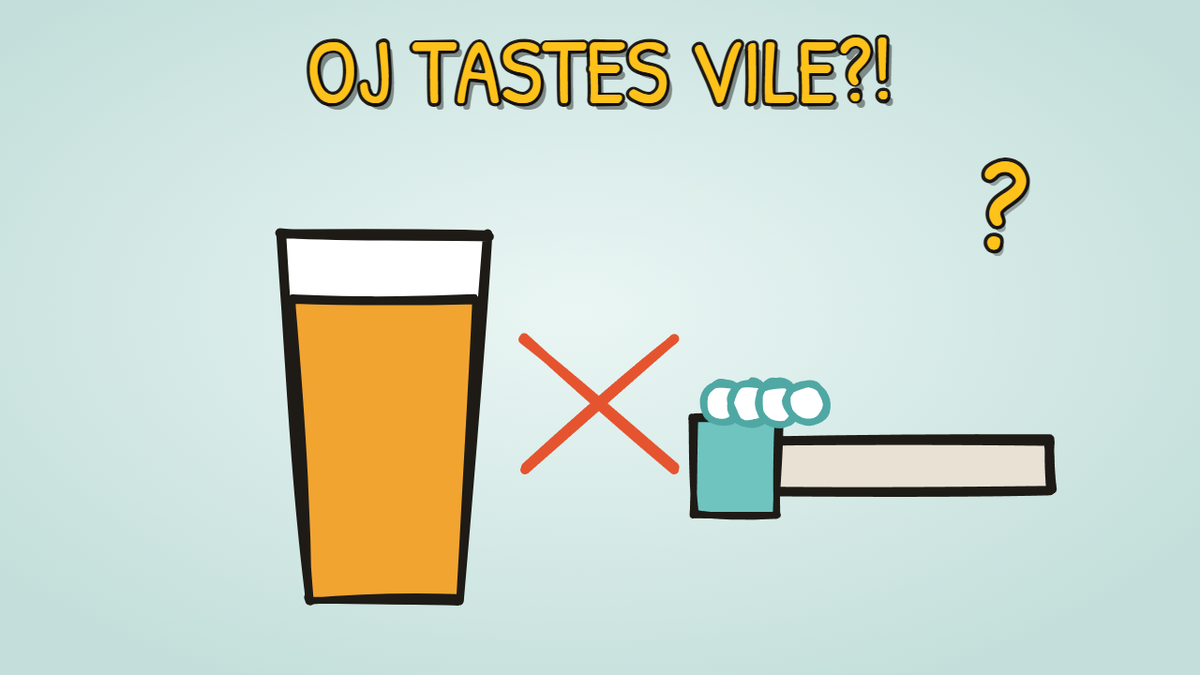
The animated version
Same answer, told as a little animated story with the strange little stickman acting it out. Dry, quick, and — obviously — correct.
▶ Video dropping soon — subscribe on YouTubeQuick questions
Why does orange juice taste bad after brushing your teeth?
Because of a detergent in most toothpaste called sodium lauryl sulfate (SLS). It does two things at once: it temporarily suppresses your sweet-taste receptors, and it dissolves a fatty film on your tongue that normally keeps bitterness dialled down. Orange juice relies on its sweetness to balance its sourness and bitterness — take the sweetness away and it turns sharp and bitter.
Is it the mint in toothpaste that ruins orange juice?
No — that's the common assumption, but it's wrong. You'd get the same unpleasant effect with a flavourless toothpaste, as long as it contained SLS. The mint is innocent; the foaming agent is the villain.
How do you stop toothpaste from ruining your orange juice?
The simplest fixes are to wait — the effect fades on its own as saliva washes the SLS away — or to have your juice before you brush. If it really bothers you, switch to an SLS-free toothpaste, which sidesteps the problem entirely.
How long does the toothpaste taste effect last?
Usually a matter of minutes, though estimates vary — many sources put it anywhere from about five minutes to half an hour, depending on the toothpaste, how well you rinse, and your own sensitivity. Once your saliva clears the SLS, taste returns to normal.
What is SLS in toothpaste?
Sodium lauryl sulfate is a surfactant — a detergent — added to toothpaste to make it foam. The foam helps spread the paste and lift debris, but the same detergent action is what temporarily meddles with your sense of taste.
Our sources
// every claim on this page was checked before it went up