Here is a genuinely unsettling experiment you can run tonight, with nothing but a mirror and a light switch. Dim the room until it's just gloomy. Find a mirror. Then look straight into your own reflected eyes — and hold it. Don't glance away, don't scan around. Just keep staring, steadily, into your own eyes. Within a minute or two, the face looking back at you will begin to change. It warps. The features slide and swell. And quite quickly, the person in the mirror stops feeling like you at all.
01 · The dareA dim room, a mirror, and your own eyes
The recipe matters, and it’s very specific: low light and a fixed, unbroken stare. Not pitch dark — you need to still make out your face — but dim enough that contrast drops and the edges of things go soft. Then you lock your gaze onto your own eyes and refuse to let it wander. That’s the whole setup. No chanting, no candles required. Just the gloom and the discipline not to look away.
And this isn’t a spooky story someone made up. It’s a documented, replicable phenomenon with a name — the strange-face-in-the-mirror illusion — and it happens to ordinary, perfectly healthy people with remarkable reliability.
02 · The evidenceWhat 50 people actually saw
In 2010, a researcher named Giovanni Caputo sat 50 healthy volunteers in front of a mirror in a dimly lit room — a single 25-watt lamp behind them — for about ten minutes each, and simply asked them to watch their own face. The results, published in the journal Perception, are the reason we’re talking about this at all.
Nearly two-thirds watched their own face grotesquely distort. But it went much further than that. Around half reported a monstrous or fantastical being. Others saw a complete stranger staring back. Some saw an animal’s face — a cat, a pig. And a striking number saw the faces of their own parents, or of relatives who had died. The specific vision differed wildly from person to person; what almost everyone shared was the eerie feeling of otherness — that the face was no longer theirs.
03 · Not the mirrorIt works with two people, too
If you think a mirror might be doing something strange, Caputo checked. In later work he sat two people down in a dim room and had them simply gaze into each other’s eyes for about ten minutes. The effect got stronger. Each person watched the other’s face melt and shift — into strangers, into monsters, into the faces of the dead — and the sense of dissociation deepened.
So this clearly isn’t about mirrors being magic. Swap your reflection for a real human face and it still happens. That’s the tell. The illusion isn’t in the glass. It’s in you — in how your eyes and your brain handle a still face held too long in the dark.
04 · The fadeWhy your features start to dissolve
So what’s actually going on? The leading explanation starts with a quirk of your visual system called Troxler fading, described way back in 1804. Here’s the principle: your neurons are built to shout about change and to fall silent about anything that stays the same. Hold your gaze perfectly still, and anything unchanging — especially toward the edges of your vision, and especially in low contrast — slowly stops being registered at all. It literally fades out of awareness.
Normally you never notice this, because your eyes make constant tiny involuntary movements that refresh the image. But fixate hard, in the gloom, and adaptation wins. As you lock onto your own eyes, your still cheeks, your nose, your jaw drift toward the periphery and begin to dissolve. Chunks of your face quietly go missing.
Your brain has a whole region dedicated to reading faces, and it will not tolerate a half-erased one. So when the picture goes to mush, it does what it always does — it fills in the gaps. Except now it's guessing from almost nothing. And it guesses wrong.
05 · The fillA face stitched out of shadows
That face-processing system is relentless and fast — it’s the same machinery that spots a face in a cloud or a plug socket. Give it a full, well-lit face and it works flawlessly. But feed it a fading, low-contrast, half-vanished face and it doesn’t shrug and give up. It keeps generating a face anyway, pattern-matching against its enormous internal library of every face it has ever known.
So it stitches something together out of the shadows and the scraps still coming through — and what it produces can be a monster, a stranger, an animal, a dead parent. The “monster in the glass” is built from nothing but your own fading face and your own busy brain filling in the dark. It was never in the mirror at all.
06 · The self slipsWhy it stops feeling like you
There’s a second layer sitting on top of the visual glitch, and it’s what makes the whole thing so disquieting. Staring at yourself like this, in the gloom, seems to loosen something in the brain — a mild, temporary form of dissociation. Your normal, automatic sense of that’s me quietly lets go.
This is exactly the part that got stronger in the two-person version of the experiment, where Caputo measured real dissociative effects. It’s why the warped face you’re now seeing doesn’t merely look strange — it feels like it belongs to someone else entirely. The illusion isn’t only that your face changed. It’s that you stopped recognizing it as yours. (Worth saying plainly: the precise mechanism tying all this together is still debated. This is the leading account, not the last word.)
07 · The old magicEvery ghost in every mirror
And this probably explains something very old. For centuries, people have gazed into mirrors and dark pools by candlelight, trying to summon spirits, or the dead, or a glimpse of a future face. Bloody Mary in the bathroom mirror is just the modern, playground version of a tradition that runs back through obsidian scrying glasses and firelit divination.
It turns out a flickering candle and a steady stare are the near-perfect recipe for this exact illusion — dim light, low contrast, a fixed gaze, a face held too long. They weren’t summoning anything. They were running a glitch. (That’s the likely explanation, not a documented account of what any given ritual was “really” doing — but the fit is hard to ignore.)
And that’s the quietly unsettling payoff. The face you think of as simply, permanently yours is something your brain has to actively keep redrawing, moment to moment, out of a stream of tiny eye movements and constant fresh input. Hold still, stare too long into the dark, and it just — comes apart in your hands.
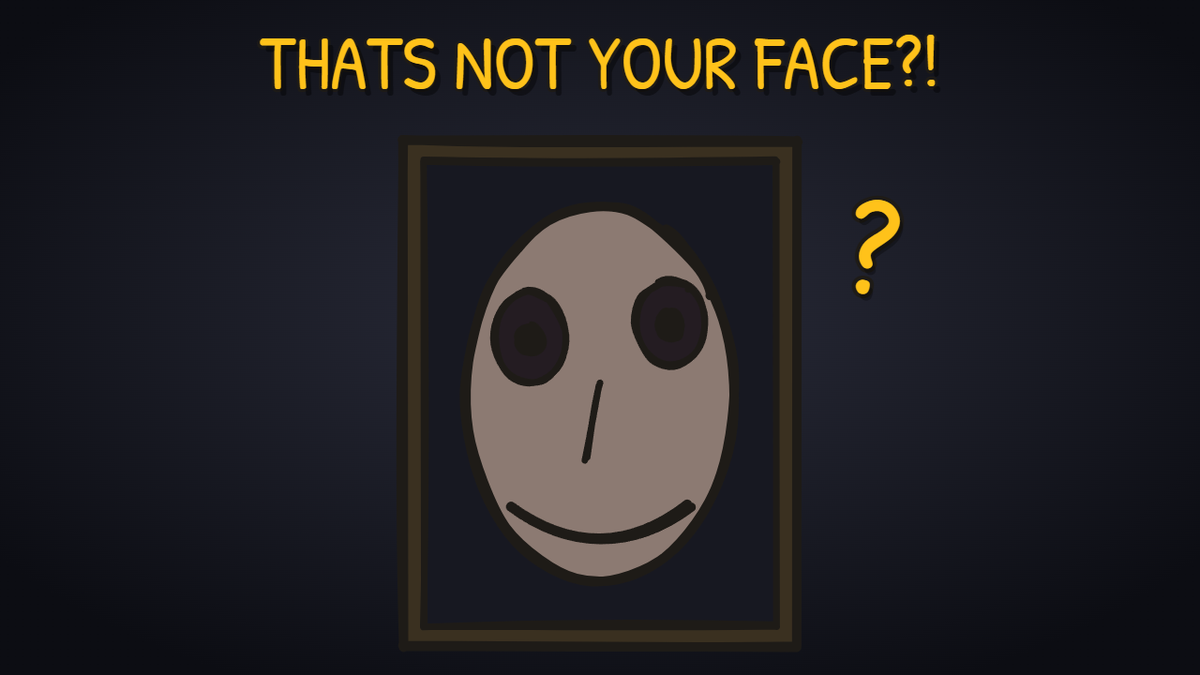
The animated version
Same answer, told as a little animated story with the strange little stickman acting it out. Dry, quick, and — obviously — correct.
▶ Video dropping soon — subscribe on YouTubeQuick questions
Why does my face look weird when I stare in the mirror?
Because holding a fixed gaze in low light triggers the strange-face illusion. Your still features fade from perception (Troxler fading), your brain's face system fills the gaps with a fabricated face, and a mild dissociation loosens your sense that the reflection is you. It's a normal perceptual glitch, not a sign anything is wrong.
Is the strange-face-in-the-mirror illusion real or a hoax?
It's real and well documented. Psychologist Giovanni Caputo first reported it in the journal Perception in 2010, and it has been replicated many times since. It reliably happens in healthy people after a few minutes of mirror-gazing in dim light.
What is the science behind Bloody Mary and mirror rituals?
The classic setup — a dark room, a mirror, candlelight, a long unblinking stare — is almost exactly the condition that produces the strange-face illusion. Researchers think that's likely why people 'see' faces during these rituals: it's the brain misfiring, not a spirit appearing. This is a plausible explanation, not proven history.
Does everyone see the same thing in the mirror illusion?
No. Reports vary widely — from mild distortions to a completely unknown person, an animal, an archetypal 'old woman' or child, or the face of a parent or deceased relative. What stays consistent across people is the strong feeling of 'otherness' — that it isn't you.
Does the strange-face illusion happen with two people too?
Yes. When two people sit in dim light and gaze into each other's eyes for about ten minutes, the same effect appears — and Caputo found it comes with even stronger dissociation. So it isn't about mirrors being special; it's about your visual system and your sense of self.
Is it safe or bad for you to try?
For most people it's a harmless curiosity that ends the moment you look away or turn the lights up. The effects are temporary. If staring at your own reflection routinely makes you feel distressed or detached, that's worth mentioning to a professional — but the illusion itself is a normal quirk of perception.
Our sources
// every claim on this page was checked before it went up