Open Homer's Odyssey, three thousand years old, and you'll trip over something genuinely strange. The sea isn't blue — it's the wine-dark sea. The sky is bronze. Sheep are violet, honey is green. Homer paints an entire world in colour and never once reaches for the word blue. And here is the stranger part: he isn't the exception. Blue is the great no-show of the ancient world.
01 · The countA scholar actually tallied it up
In 1858, a British scholar named William Gladstone — later the Prime Minister — did the unglamorous thing and counted. Across Homer’s epics, words for black turn up around 170 times, white around a hundred, and other hues like red and green only around ten times apiece. And blue? Essentially zero. Not a single clear, dedicated use of the word. For a poet this vivid, that’s not a rounding error. That’s a hole shaped exactly like a colour.
02 · EverywhereIt isn't just the Greeks
You might file that under “quirk of one ancient poet” — except the same gap turns up everywhere you look. Comb through ancient Hebrew, old Chinese, early Japanese, the Icelandic sagas, and blue keeps going missing. A 19th-century philologist named Lazarus Geiger followed Gladstone’s thread across cultures and found the pattern held again and again. Whatever’s going on, it’s not local to Athens. It’s something close to universal.
03 · Not blindnessTheir eyes were the same as yours
The tempting conclusion is that the ancients were somehow colour-blind to blue. They were not — and this is the myth worth killing. Their eyes were biologically identical to ours; blue light hit their retinas exactly as it hits yours. Gladstone’s actual, subtler point was that they sorted the world more by light and dark — by brightness — than by hue. They could see the blue of the sky perfectly well. They just hadn’t carved “blue” out into its own named category yet.
04 · The orderColours get named in almost the same running order
In the 1960s, two Berkeley researchers, Brent Berlin and Paul Kay, made this concrete. Surveying language after language, they found that basic colour words tend to arrive in a near-fixed sequence. First a word for dark and a word for light. Then red. Then green and yellow. And blue is nearly always the last one to show up. Their model has been poked and refined in the decades since — it’s a strong pattern rather than an iron law — but the headline has held remarkably well: blue comes late, almost everywhere.
05 · The reasonBlue barely exists in the world you can touch
So why is blue always last? Because it’s astonishingly rare in the natural world. There’s effectively no blue food. Very few blue animals — and most of the ones that look blue, from jays to morpho butterflies, are cheating with structural colour, tiny light-scattering ridges rather than any actual blue pigment. Crush a blue feather and it turns dull grey. Fewer than one in ten flowering plants are blue. Yes, the sky and the sea read as blue — but you can’t hold them, or pick one up, or dye a cloak with them. Blue is everywhere you look and almost nowhere you can grab.
And you couldn’t make it, either. Red came easily from clay and berries; yellows and browns from the earth. But a good, stable blue was fiendishly hard to produce — so the colour barely showed up in the things people actually owned and had reason to name.
06 · The exceptionEgypt cracked it — and named it
With one glittering exception. The ancient Egyptians manufactured Egyptian blue, heating silica, lime, copper and an alkali into what’s widely called the first synthetic pigment in history. And, almost alone in the ancient world, they also had a proper word for blue — though tellingly, it grew out of their word for lapis lazuli, the precious blue stone they were imitating. The lesson is neat: the word for the colour arrives right around the moment you can hold the colour in your hand.
If this were only ancient history, it'd be a curiosity. But whether your language splits a colour off with its own name still seems to shape how quickly you notice it — today, in living speakers.
07 · The modern echoDoes a name change what you see?
This is where it gets carefully interesting, so let’s be precise. You may have heard the striking story of the Himba people of Namibia — who use one word covering what we’d split into green and blue — being shown a ring of green squares with one obvious blue among them, and failing to spot it. That vivid version was dramatised for a BBC documentary, and the scientists involved never actually published it that way. So treat the tidy “they can’t see the blue square” tale with suspicion.
The real, peer-reviewed finding is subtler, and arguably more interesting. Language seems to sharpen your perception right at the boundaries your language happens to mark. Himba speakers, whose language carves up greens more finely than English does, can be quicker at telling apart green shades that leave us squinting — an advantage sitting exactly on a line their words draw. And in a cleaner, well-replicated case: Russian has two separate basic words for blue — goluboy (light) and siniy (dark) — and Russian speakers are measurably faster at distinguishing two blues when the pair straddles that boundary. Not a different eye. A different filter, laid down by the words.
08 · The payoffSo why did no one have a word for blue?
Because the sky was blue for tens of thousands of years before anyone found a reason to say so. Blue was real, and visible, and everywhere — but it was rare in the things people could hold, nearly impossible to make, and so it was the last colour languages got around to naming. The ancients weren’t blind to it. They just hadn’t met the word yet. And that turns out to be the quiet moral of the whole story: a colour can sit right there in front of your eyes and barely grab your attention — until your language finally hands it a name to hang on.
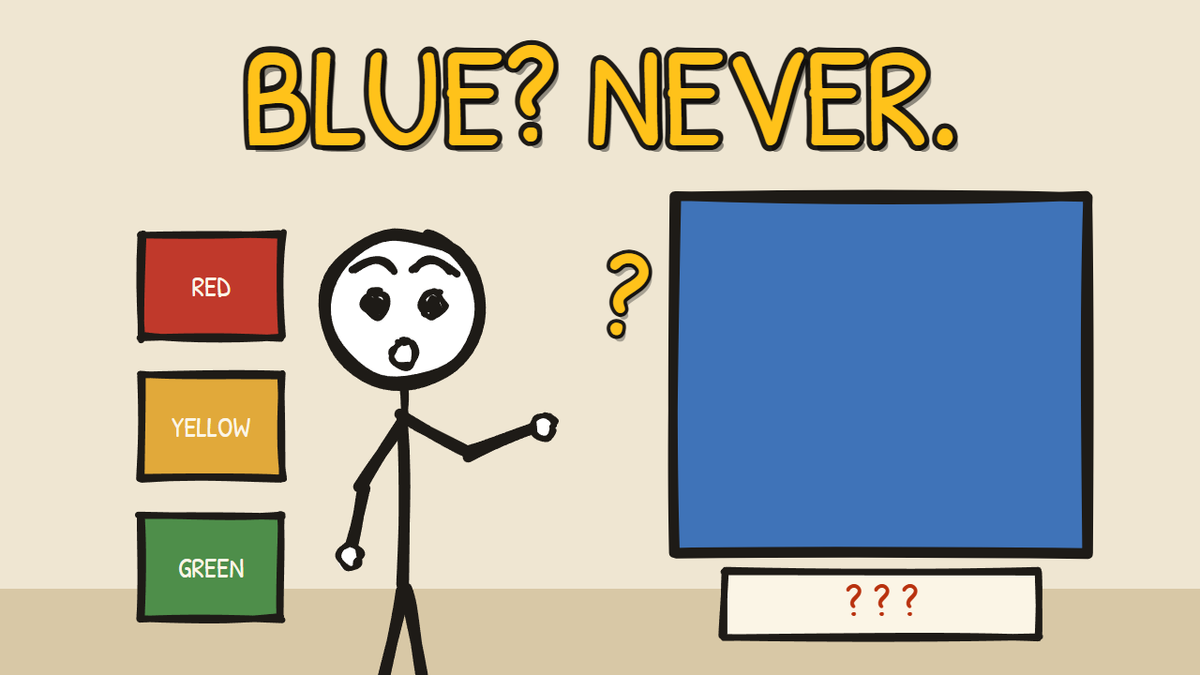
The animated version
Same answer, told as a little animated story with the strange little stickman acting it out. Dry, quick, and — obviously — correct.
▶ Video dropping soon — subscribe on YouTubeQuick questions
Could the ancient Greeks see the colour blue?
Yes. Their eyes were biologically identical to ours, so they saw blue light exactly as we do. What they lacked was a common, dedicated word for it — Gladstone's real argument was that they ranked colour more by brightness (light vs. dark) than by hue. The claim that they "literally couldn't see blue" is a myth.
Why is blue the last colour to be named?
Because it barely turns up in the world you can touch. There's essentially no blue food, very few blue animals, and blue flowers are rare — and for most of history a stable blue dye was extremely hard to make. So even though the sky and sea look blue, blue rarely appeared in things people owned and pointed at, and languages were slow to give it a name.
What is the "wine-dark sea"?
It's Homer's recurring description of the sea (Greek oînops, "wine-faced"). He never calls the sea blue; he also calls the sky bronze and describes sheep as violet and honey as green — using words that track brightness and quality of light more than the specific hues we'd reach for.
What was the first blue pigment?
Egyptian blue, made by ancient Egyptians from heated silica, lime, copper and an alkali. It's widely regarded as the world's first synthetic pigment — and, tellingly, Egypt was also one of the very few ancient cultures with a dedicated word for blue, though that word grew out of their term for lapis lazuli.
Does having a word for a colour change how you see it?
It appears to nudge perception at the edges rather than transform it. Russian, which has separate basic words for light blue (goluboy) and dark blue (siniy), makes its speakers measurably faster at telling two blues apart when they straddle that boundary. The effect is real but subtle — language sharpens attention at category lines, it doesn't invent colours you can't otherwise see.
Our sources
// every claim on this page was checked before it went up