It's three in the morning and you are wide awake, staring at the ceiling. And riding in behind the tiredness comes the dread: my sleep is broken, I'll be a wreck tomorrow, what is wrong with me? Here's the reassuring part. For most of recorded history, waking in the dead of night wasn't a problem at all. It was ordinary — a scheduled part of the night — and people rather looked forward to it.
01 · The patternPeople didn't sleep in one block. They slept in two.
For centuries, the normal thing was not to sleep in a single long stretch the way we try to. You slept in two. There was a first sleep and a second sleep, with a deliberate stretch of wakefulness sitting between them. Not an accident, not a fault — a structure. And this isn’t a romantic guess about the past. It rests on a genuine mountain of written evidence.
02 · The receipts2,000 references, in a dozen languages
The person who pieced this together is a historian named A. Roger Ekirch. He spent years combing the records of ordinary life — diaries, court testimony, novels, medical books, prayer manuals — and kept hitting the same two phrases, over and over: “first sleep” and “second sleep.” His original book, At Day’s Close, turned up over 500 such references; he has since gathered more than two thousand, in a dozen languages, stretching back as far as ancient Greece. People wrote about it so casually, and explained it so rarely, that the meaning is unmistakable: everyone simply knew what it was.
03 · The nightHow a night actually worked
So here is the shape of it. You’d go to bed not long after dark and drop into your first sleep — three or four hours of it. Then, around midnight, you would surface. No alarm, no alarm bell of panic either; your body just gently woke. You’d be up for an hour or two, and then sink back down into your second sleep until dawn. That midnight gap wasn’t a malfunction that needed fixing. It was an expected chapter of the night, and it even carried a name in some accounts: the watch.
04 · The watchA rather lovely hour to be awake
By many accounts, that waking hour was genuinely pleasant. In the calm and the candlelight, people prayed and read. They poked at the fire and chatted quietly with the rest of the household. They visited neighbours. They had sex. And, lying there in the half-dark, they turned over the dreams they’d just had, while the dreams were still warm. It was a private, peaceful little pocket of time — and one we’ve very nearly lost entirely.
05 · The culpritWhat killed it: light
So what happened to it? The single biggest answer is light. As streets and then homes filled with lamplight, then gas, then electricity, the evening stopped ending at sunset. Bedtimes slid later, the night grew shorter, and the two separate sleeps got quietly squeezed into one solid block. The new world of clocks, factories, and efficiency did the rest — and the gentle waking hour was rebranded as a problem with a clinical name: insomnia. It’s worth noting Ekirch himself came to see the shift as messier than light alone; industrial time-discipline and changing attitudes to rest mattered too. But of all the forces at work, artificial light left the broadest and most lasting mark.
If light really erased the old pattern, then taking the light away should bring it back. In 1992, a scientist put exactly that to the test — and it worked.
06 · The proofGive people long nights, and the split returns
The researcher was Thomas Wehr, working at the US National Institute of Mental Health. He took a group of healthy volunteers and gave them fourteen hours of darkness every night for weeks — roughly the long, dark nights our ancestors endured every winter. And after a few weeks, with no instruction whatsoever, their sleep quietly reorganised itself into two. A chunk of sleep of three to five hours, then an hour or two of calm wakefulness, then a second chunk of similar length. Their melatonin — the darkness hormone — even spread out over a longer window to match. Remove the artificial light, and the old firmware reboots on its own.
07 · The catchHow settled is any of this?
Now, a fair word of caution, because the accuracy is the point. Ekirch’s evidence is genuinely vast, and his account is the leading one — but it isn’t beyond dispute. Some historians read the same old texts as more ambiguous than a single, tidy, everyone-did-this pattern. And sleep scientists have pointed out that equatorial hunter-gatherer groups studied today don’t obviously sleep in two shifts — which hints the two-sleep habit may be tied specifically to the long, dark winter nights of higher latitudes rather than being some universal human default. The honest version is: the pattern was real and widespread in early-modern Europe, and it returns under long nights in the lab. Whether everyone, everywhere, always slept this way is a claim worth keeping loose.
08 · The payoffSo why did people sleep twice a night?
Because, for a long stretch of human history in the parts of the world with real winters, that’s simply what the dark did to us. Long nights split sleep in two and left a quiet island of wakefulness in the middle — time to pray, to talk, to remember a dream. The lightbulb filled in the dark, pushed the two halves together, and then handed us a word — insomnia — for the leftover gap it never quite managed to erase. So the next time you find yourself blinking at the ceiling at three in the morning, calm and clear and unable to drop straight back off, don’t despair. You may just be running a very old piece of human software. Use the hour well — though, for everyone’s sake, maybe don’t go and wake the neighbours.
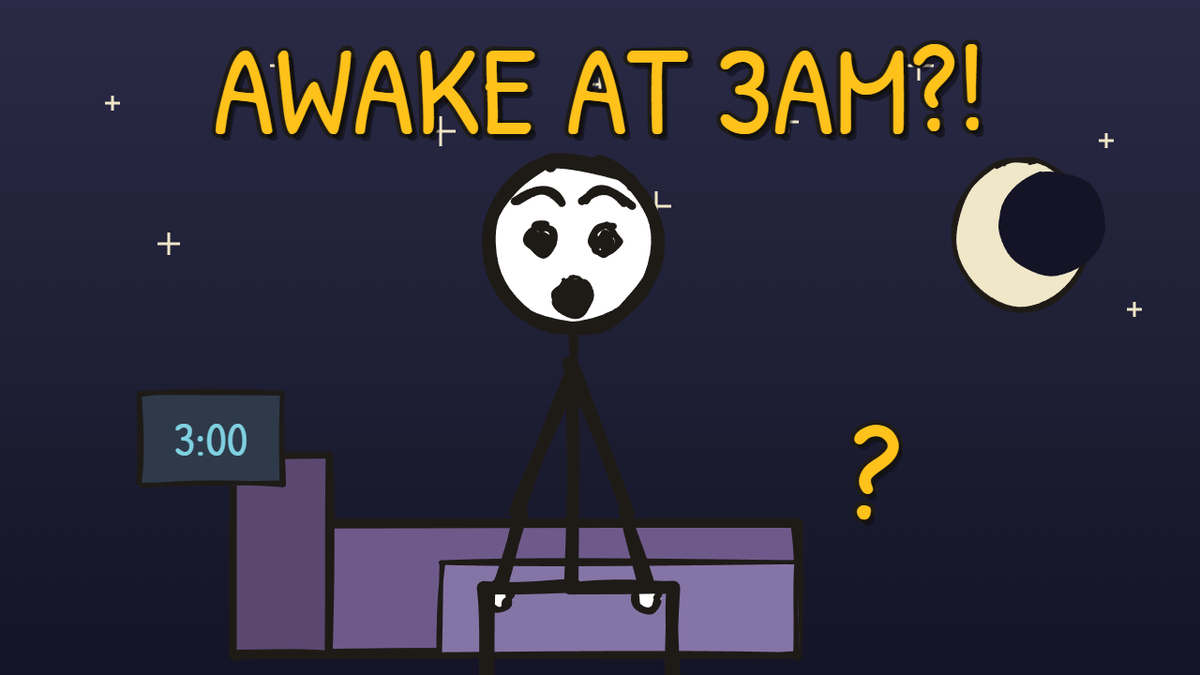
The animated version
Same answer, told as a little animated story with the strange little stickman acting it out. Dry, quick, and — obviously — correct.
▶ Video dropping soon — subscribe on YouTubeQuick questions
Is waking up at 3am a sign of insomnia?
Not necessarily. Waking in the night was completely normal for centuries — the gap between "first" and "second" sleep. If you wake feeling calm and simply can't drop straight back off, that quiet wakefulness may be a very old, natural pattern rather than a disorder. The panic and exhaustion are more modern additions than the waking itself.
What is segmented or biphasic sleep?
It's sleeping in two separate blocks rather than one. Historically that meant a "first sleep" of three or four hours after dark, an hour or two of wakefulness around midnight, then a "second sleep" until dawn — with the middle stretch treated as a normal, even pleasant, part of the night.
Why did people stop sleeping in two shifts?
The leading explanation is artificial light. As lamps, gas, and then electricity spread, evenings stopped ending at sunset, bedtimes slid later, and the two sleeps got compressed into one. Ekirch notes the shift was more tangled than light alone — industrial time-discipline and changing attitudes to work and rest mattered too — but light exerted the broadest effect.
Did everyone in history sleep this way?
That's genuinely debated. Ekirch's written evidence is vast, but some historians and sleep scientists argue the record is more ambiguous than a single tidy pattern, and note that equatorial hunter-gatherer groups studied today don't show it — hinting the two-sleep habit may be tied to long, dark, higher-latitude winter nights.
What was "the watch"?
It's one name for the wakeful hour between the two sleeps. In the candlelight, people prayed, read, poked the fire, chatted with the household, visited neighbours, had sex, and reflected on the dreams they'd just had while they were still fresh.
Our sources
// every claim on this page was checked before it went up