In the middle of Rome stands the Pantheon: a vast concrete dome, with no steel inside it, poured almost two thousand years ago. It is still standing there, perfectly. Meanwhile, motorway bridges built within living memory are already cracked, crumbling, and held together with scaffolding. The Romans had no chemistry, no labs, no engineers as we'd recognise them. So how on earth did they make concrete that outlasts ours by centuries?
01 · The mysteryA dome that shouldn't still be standing
The Pantheon is the proof that starts every argument about Roman concrete. Its dome is the largest unreinforced concrete dome in the world — a title it has held for nearly nineteen centuries — and it was poured around AD 126 with no steel skeleton inside it at all. For a very long time, we assumed the secret was simply a lost recipe. The truth is stranger: the Romans baked an actual ability into their concrete. The power to heal its own cracks. And, astonishingly, we only really worked out how it does that in 2023.
02 · Why ours failsThe steel that eventually betrays it
Start with the modern problem. Our concrete is strong, but it’s brittle, and it cracks. Water then seeps into those cracks, and in most modern structures it reaches the steel reinforcing bars — the rebar — hidden inside. That steel begins to rust. And here’s the killer detail: rust takes up more space than the steel it replaces. So as the rebar corrodes, it swells, prising the concrete apart from the inside out. A few decades of that, and the whole thing is spalling and falling to bits. Rebar corrosion is responsible for the great majority of damage in reinforced concrete structures.
03 · The recipeLime, ash, and a splash of seawater
The Roman recipe was completely different. They mixed lime with chunks of volcanic ash — pozzolana — and rock. And for their harbours and sea walls, they did something that sounds insane: they mixed the whole thing with seawater. The exact substance that eats modern marine concrete alive. That choice turns out to be the first piece of the magic.
04 · The seaConcrete that grows stronger in salt water
In those Roman sea walls, the seawater doesn’t wear the concrete down. It soaks in, dissolves the volcanic ash, and slowly grows brand-new, interlocking crystals right inside the material — a rare mineral called aluminous tobermorite, which the geologist Marie Jackson traced through decades of study. The platy crystals knit the cement together and resist cracking. So instead of being eroded by the sea, the concrete is quietly reinforced by it, getting tougher century after century. It is, almost literally, concrete that grows new bones.
05 · The flaw that wasn'tThe white lumps we mocked for a century
But the biggest secret was hiding in plain sight. Look closely at Roman concrete and it’s freckled with little white lumps of lime, called lime clasts. For over a hundred years, scientists looked at those lumps and sniffed: shoddy work, bad mixing, a sign the Romans were careless. Then, in 2023, a team led by MIT asked a better question — why would master builders who left us the Pantheon be this sloppy? — and realised those little lumps were the entire masterstroke.
The Romans mixed their lime scorching hot — a technique called "hot mixing" with quicklime — which left thousands of tiny, highly reactive lime nuggets scattered through the concrete. Not sloppy leftovers. A thousand dormant little repair kits.
06 · The healingHow a crack seals itself
Here’s what those lime clasts do. When a crack forms and rainwater trickles in, the water reaches one of those reactive lumps and dissolves the calcium inside it. The dissolved lime then recrystallises as calcium carbonate, right across the crack — growing brand-new material that fills the gap almost like glue and stops the crack spreading. The MIT team watched it happen: in the lab, water was flowing straight through a cracked sample, and within thirty days the crack had sealed itself completely. No engineer, no repair crew. Just water, and chemistry.
07 · The payoffThe Romans were right all along
So Roman concrete isn’t tougher than ours because of some lost, mystical art. It’s tougher because it’s riddled with tiny, built-in first-aid kits, and because the sea grows it new material rather than destroying it. We pour smooth, flawless concrete and wrap it around steel that eventually betrays it. They poured lumpy, imperfect concrete that quietly repairs itself. The little flaws we sneered at for a century — the sloppy lumps, the “bad mixing” — turn out to be the single cleverest part of the whole design. Two thousand years of being quietly patronised, and the Romans were right all along. Which is exactly why we’re now racing to copy them.
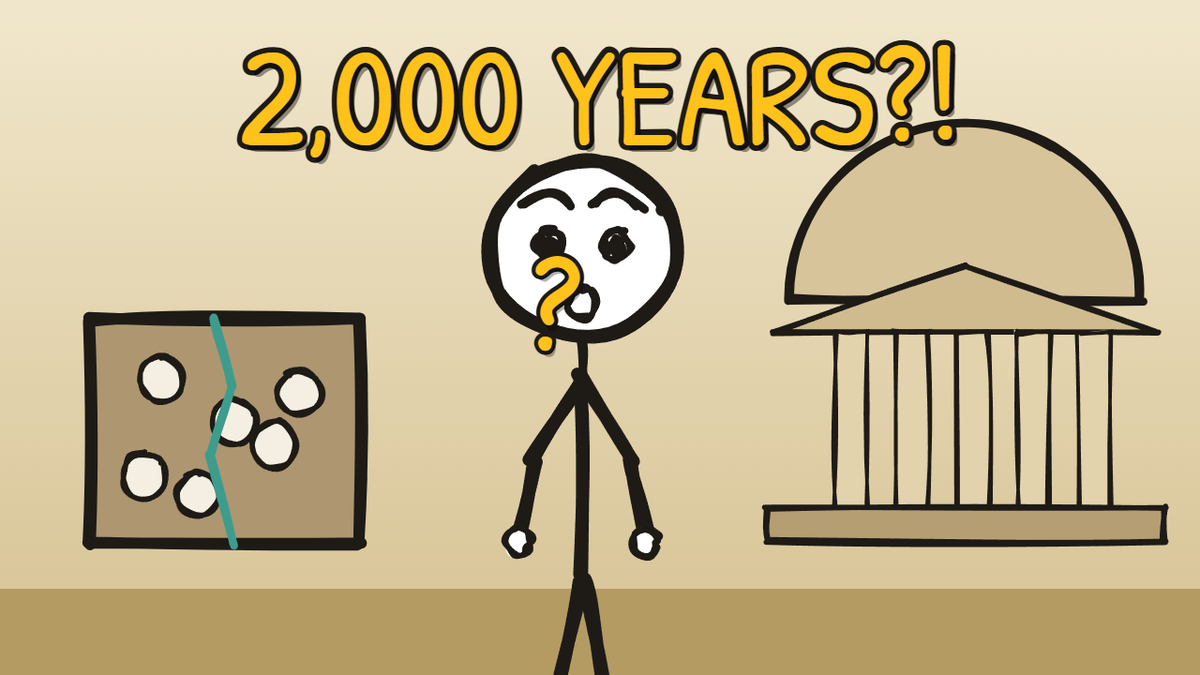
The animated version
Same answer, told as a little animated story with the strange little stickman acting it out. Dry, quick, and — obviously — correct.
▶ Video dropping soon — subscribe on YouTubeQuick questions
Why is Roman concrete so much more durable than modern concrete?
Two reasons. First, it can heal its own cracks: tiny lime lumps in the mix dissolve when water reaches a crack and recrystallise to seal it. Second, modern concrete relies on steel rebar that rusts and swells once water gets in, tearing the structure apart — a failure mode Roman concrete simply doesn't have.
How does Roman concrete heal itself?
It's studded with small white 'lime clasts.' When a crack forms and water trickles in, the water dissolves the calcium in a nearby lime clast; the dissolved lime then recrystallises as calcium carbonate right across the crack, filling it like glue. MIT researchers demonstrated this healing in the lab in 2023.
What is Roman concrete made of?
Lime, volcanic ash (pozzolana), and rock aggregate, mixed with water. For harbours and sea walls they used seawater. The key extra step was 'hot mixing' with quicklime, which left the reactive lime clasts that give the material its self-healing ability.
Does seawater make Roman concrete stronger?
In their marine structures, remarkably, yes. Geologist Marie Jackson's research found that seawater percolating through the concrete dissolves the volcanic ash and grows rare interlocking crystals (aluminous tobermorite) inside it, reinforcing the material over centuries — the opposite of how seawater destroys modern concrete.
Why doesn't modern concrete last as long as Roman concrete?
Modern reinforced concrete is strong but brittle, and it cracks. Water seeps in and reaches the steel rebar, which rusts. Rust takes up more space than steel, so it swells and cracks the concrete open from within — a process that can degrade structures within decades. Roman concrete has no steel to corrode and can reseal its own cracks.
Our sources
// every claim on this page was checked before it went up